
MHC Class I (YD19113) Rabbit mAb (Cat.#:AYD11335)
小A
Sales advisor

Scan with WeChat to add an advisor
Cat.#:AYD11335
| Size | Price | |
|---|---|---|
| 50ul | RMB: 680Sale1280 | Add to cart |
| 100ul | RMB: 1219Sale2300 | Add to cart |
Sales Terms | Request COA | Stock and shipping are confirmed by support
Information
Application guide
Related products
Immunogen
Target data
Resources
Protocols
FAQs
| Reactivity | Human |
|---|---|
| Host | Rabbit |
| Clonality | Monoclonal |
| Isotype | IgG |
| Application | WBIHC-PICC/IFFCIP |
| Dilution | |
| Predicted MW | 40kDa/41kDa/41kDa |
| Observed MW | |
| Format | Liquid |
| Storage | Store at -20℃. Avoid freeze / thaw cycles. Buffer: PBS with 0.75% BSA,50% glycerol,pH7.3. |
| Conjugate | Unconjugated |
| Positive | 无明确组织表达 |
| Subcellular | Cell membrane, Endoplasmic reticulum membrane |
| Purification | 亲和纯化 |
Applications and conditions
These starting conditions come from the recommended dilution, validation images, and general assay practice. Titrate for your sample and detection system.
| Recommended dilution | See the validation images or contact technical support |
|---|---|
| Suggested sample / positive control | 无明确组织表达 |
| Key conditions | Use a fresh lysate, incubate at the recommended dilution, and check the predicted and observed molecular weight |
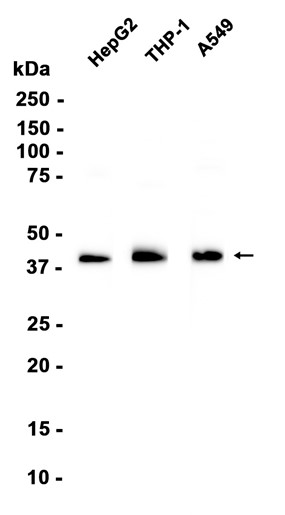
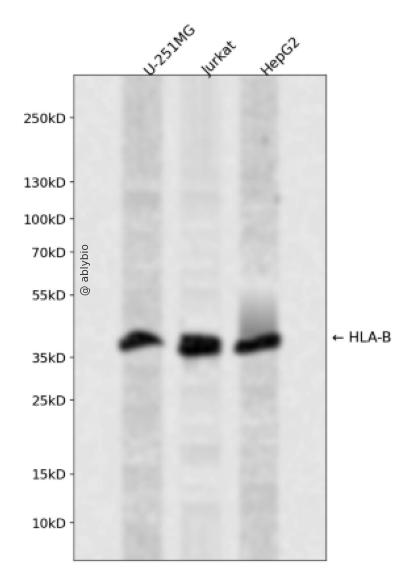
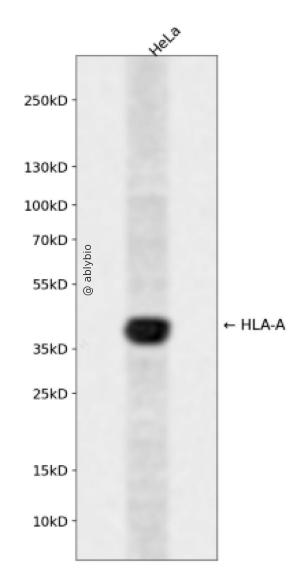
| Expected result | Expected signal or band near 40kDa/41kDa/41kDa |
| Controls | Include a positive sample, a negative sample, and a secondary or isotype control |
| Recommended dilution | See the validation images or contact technical support |
|---|---|
| Suggested sample / positive control | 无明确组织表达 |
| Key conditions | For paraffin sections, optimize retrieval buffer pH, retrieval time, and primary incubation |
| Expected result | Expected localization: Cell membrane, Endoplasmic reticulum membrane |
| Controls | Include a positive sample, a negative sample, and a secondary or isotype control |
| Recommended dilution | See the validation images or contact technical support |
|---|---|
| Suggested sample / positive control | 无明确组织表达 |
| Key conditions | Optimize fixation, permeabilization, and blocking, and include a secondary-only control |
| Expected result | Expected fluorescence localization: Cell membrane, Endoplasmic reticulum membrane |
| Controls | Include a positive sample, a negative sample, and a secondary or isotype control |
| Recommended dilution | See the validation images or contact technical support |
|---|---|
| Suggested sample / positive control | 无明确组织表达 |
| Key conditions | For intracellular targets, optimize fixation and permeabilization, and include an isotype control |
| Expected result | Expect the positive population to shift relative to the negative or isotype control |
| Controls | Include a positive sample, a negative sample, and a secondary or isotype control |
| Recommended dilution | See the validation images or contact technical support |
|---|---|
| Suggested sample / positive control | 无明确组织表达 |
| Key conditions | Start at the recommended dilution and titrate for your sample and assay |
| Expected result | Expected signal or band near 40kDa/41kDa/41kDa |
| Controls | Include a positive sample, a negative sample, and a secondary or isotype control |
Related products
More associated products >>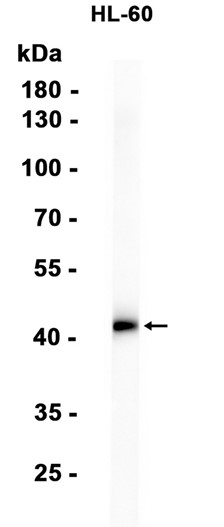
Immunogen
| Immunogen | Please contact Support |
|---|---|
| Sequence | Request sequence |
Target data
| Background | Antigen-presenting major histocompatibility complex class I (MHCI) molecule. In complex with B2M/beta 2 microglobulin displays primarily viral and tumor-derived peptides on antigen-presenting cells for recognition by alpha-beta T cell receptor (TCR) on HLA-B-restricted CD8-positive T cells, guiding antigen-specific T cell immune response to eliminate infected or transformed cells (PubMed:23209413, PubMed:25808313, PubMed:29531227, PubMed:9620674). May also present self-peptides derived from the signal sequence of secreted or membrane proteins, although T cells specific for these peptides are usually inactivated to prevent autoreactivity (PubMed:18991276, PubMed:7743181). Both the peptide and the MHC molecule are recognized by TCR, the peptide is responsible for the fine specificity of antigen recognition and MHC residues account for the MHC restriction of T cells (PubMed:24600035, PubMed:29531227, PubMed:9620674). Typically presents intracellular peptide antigens of 8 to 13 amino acids that arise from cytosolic proteolysis via constitutive proteasome and IFNG-induced immunoproteasome (PubMed:23209413). Can bind different peptides containing allele-specific binding motifs, which are mainly defined by anchor residues at position 2 and 9 (PubMed:25808313, PubMed:29531227) Antigen-presenting major histocompatibility complex class I (MHCI) molecule. In complex with B2M/beta 2 microglobulin displays primarily viral and tumor-derived peptides on antigen-presenting cells for recognition by alpha-beta T cell receptor (TCR) on HLA-A-restricted CD8-positive T cells, guiding antigen-specific T cell immune response to eliminate infected or transformed cells (PubMed:10449296, PubMed:12138174, PubMed:12393434, PubMed:1402688, PubMed:15893615, PubMed:17189421, PubMed:19543285, PubMed:21498667, PubMed:24192765, PubMed:24395804, PubMed:2456340, PubMed:2784196, PubMed:28250417, PubMed:7504010, PubMed:7694806, PubMed:9862734). May also present self-peptides derived from the signal sequence of secreted or membrane proteins, although T cells specific for these peptides are usually inactivated to prevent autoreactivity (PubMed:25880248, PubMed:7506728, PubMed:7679507). Both the peptide and the MHC molecule are recognized by TCR, the peptide is responsible for the fine specificity of antigen recognition and MHC residues account for the MHC restriction of T cells (PubMed:12796775, PubMed:18275829, PubMed:19542454, PubMed:28250417). Typically presents intracellular peptide antigens of 8 to 13 amino acids that arise from cytosolic proteolysis via IFNG-induced immunoproteasome or via endopeptidase IDE/insulin-degrading enzyme (PubMed:17079320, PubMed:17189421, PubMed:20364150, PubMed:26929325, PubMed:27049119). Can bind different peptides containing allele-specific binding motifs, which are mainly defined by anchor residues at position 2 and 9 (PubMed:7504010, PubMed:9862734) Antigen-presenting major histocompatibility complex class I (MHCI) molecule with an important role in reproduction and antiviral immunity (PubMed:11172028, PubMed:20104487, PubMed:20439706, PubMed:20972337, PubMed:24091323, PubMed:28649982, PubMed:29312307). In complex with B2M/beta 2 microglobulin displays a restricted repertoire of self and viral peptides and acts as a dominant ligand for inhibitory and activating killer immunoglobulin receptors (KIRs) expressed on NK cells (PubMed:16141329). In an allogeneic setting, such as during pregnancy, mediates interaction of extravillous trophoblasts with KIR on uterine NK cells and regulate trophoblast invasion necessary for placentation and overall fetal growth (PubMed:20972337, PubMed:24091323). During viral infection, may present viral peptides with low affinity for KIRs, impeding KIR-mediated inhibition through peptide antagonism and favoring lysis of infected cells (PubMed:20439706). Presents a restricted repertoire of viral peptides on antigen-presenting cells for recognition by alpha-beta T cell receptor (TCR) on HLA-C-restricted CD8-positive T cells, guiding antigen-specific T cell immune response to eliminate infected cells, particularly in chronic viral infection settings such as HIV-1 or CMV infection (PubMed:11172028, PubMed:20104487, PubMed:28649982). Both the peptide and the MHC molecule are recognized by TCR, the peptide is responsible for the fine specificity of antigen recognition and MHC residues account for the MHC restriction of T cells (By similarity). Typically presents intracellular peptide antigens of 9 amino acids that arise from cytosolic proteolysis via proteasome. Can bind different peptides containing allele-specific binding motifs, which are mainly defined by anchor residues at position 2 and 9. Preferentially displays peptides having a restricted repertoire of hydrophobic or aromatic amino acids (Phe, Ile, Leu, Met, Val and Tyr) at the C-terminal anchor (PubMed:25311805, PubMed:8265661) |
|---|---|
| Gene ID | 3106, 3105, 3107 |
| Gene name | HLA-B, HLA-A, HLA-C |
| Swiss | P01889, P30443, P30499 |
| Synonym | MHC Class I (YD19113),MHC Class I (YD19113) Rabbit mAb,HLA-B,HLA-A,HLA-C,Human leukocyte antigen B,Human leukocyte antigen A,HLA-Cw,Human leukocyte antigen C,HLAB,HLAA,HLAC |
Resources
Validation data
1 images
Validation images at the top of the page cover WB / IHC-P / ICC/IF / FC / IP.
References
No papers are linked yet. Contact technical support for application examples.
Ask for examplesCustomer reviews
No reviews yet. After use, you can submit a review and experiment images.
Send feedbackSupport
Support can help confirm the application, sample, dilution, controls, and assay conditions.
Support centerSend the catalog number, application, sample type, and assay. Support can confirm dilution, controls, and COA or lot documents.