
HSPA9 (YD36285) Rabbit mAb (Cat.#:AYD16522)
小A
Sales advisor

Scan with WeChat to add an advisor
暂无验证图
欢迎提交实验图片,或联系 Support 获取更多信息。
Cat.#:AYD16522
| Size | Price | |
|---|---|---|
| 50ul | RMB: 680Sale1280 | Add to cart |
| 100ul | RMB: 1219Sale2300 | Add to cart |
Sales Terms | Request COA | Stock and shipping are confirmed by support
Information
Application guide
Related products
Immunogen
Target data
Resources
Protocols
FAQs
| Reactivity | Human,Mouse,Rat |
|---|---|
| Host | Rabbit |
| Clonality | Monoclonal |
| Isotype | IgG |
| Application | WB |
| Dilution | |
| Predicted MW | 74kDa/73kDa/74kDa |
| Observed MW | |
| Format | Liquid |
| Storage | Store at -20℃. Avoid freeze / thaw cycles. Buffer: PBS with 0.75% BSA,50% glycerol,pH7.3. |
| Conjugate | Unconjugated |
| Positive | 无明确组织表达 |
| Subcellular | Mitochondrion, Nucleus, nucleolus, Cytoplasm, Mitochondrion matrix |
| Purification | 亲和纯化 |
Applications and conditions
These starting conditions come from the recommended dilution, validation images, and general assay practice. Titrate for your sample and detection system.
| Recommended dilution | See the validation images or contact technical support |
|---|---|
| Suggested sample / positive control | 无明确组织表达 |
| Key conditions | Use a fresh lysate, incubate at the recommended dilution, and check the predicted and observed molecular weight |
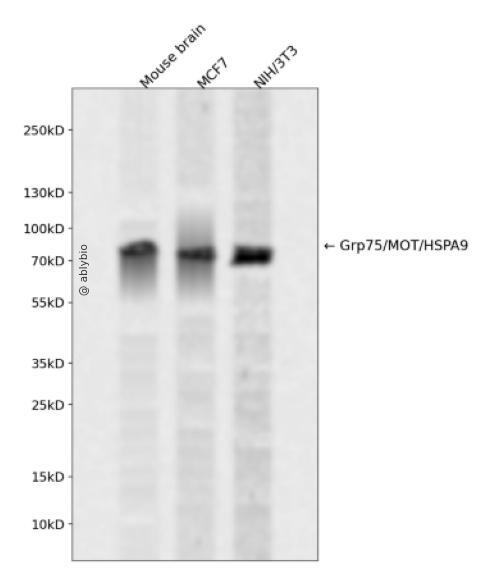
| Expected result | Expected signal or band near 74kDa/73kDa/74kDa |
| Controls | Include a positive sample, a negative sample, and a secondary or isotype control |
Related products
More associated products >>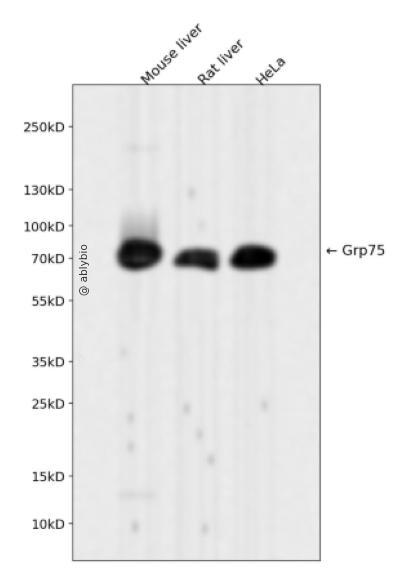
Immunogen
| Immunogen | Please contact Support |
|---|---|
| Sequence | Request sequence |
Target data
| Background | Mitochondrial chaperone that plays a key role in mitochondrial protein import, folding, and assembly. Plays an essential role in the protein quality control system, the correct folding of proteins, the re-folding of misfolded proteins, and the targeting of proteins for subsequent degradation. These processes are achieved through cycles of ATP binding, ATP hydrolysis, and ADP release, mediated by co-chaperones (PubMed:18632665, PubMed:25615450, PubMed:28848044, PubMed:30933555, PubMed:31177526). In mitochondria, it associates with the TIM (translocase of the inner membrane) protein complex to assist in the import and folding of mitochondrial proteins (By similarity). Plays an important role in mitochondrial iron-sulfur cluster (ISC) biogenesis, interacts with and stabilizes ISC cluster assembly proteins FXN, NFU1, NFS1 and ISCU (PubMed:26702583). Regulates erythropoiesis via stabilization of ISC assembly (PubMed:21123823, PubMed:26702583). Regulates mitochondrial calcium-dependent apoptosis by coupling two calcium channels, ITPR1 and VDAC1, at the mitochondria-associated endoplasmic reticulum (ER) membrane to facilitate calcium transport from the ER lumen to the mitochondria intermembrane space, providing calcium for the downstream calcium channel MCU, which releases it into the mitochondrial matrix (By similarity). Although primarily located in the mitochondria, it is also found in other cellular compartments. In the cytosol, it associates with proteins involved in signaling, apoptosis, or senescence. It may play a role in cell cycle regulation via its interaction with and promotion of degradation of TP53 (PubMed:24625977, PubMed:26634371). May play a role in the control of cell proliferation and cellular aging (By similarity). Protects against reactive oxygen species (ROS) (By similarity). Extracellular HSPA9 plays a cytoprotective role by preventing cell lysis following immune attack by the membrane attack complex by disrupting formation of the complex (PubMed:16091382) Mitochondrial chaperone that plays a key role in mitochondrial protein import, folding, and assembly. Plays an essential role in the protein quality control system, the correct folding of proteins, the re-folding of misfolded proteins, and the targeting of proteins for subsequent degradation. These processes are achieved through cycles of ATP binding, ATP hydrolysis, and ADP release, mediated by co-chaperones. In mitochondria, it associates with the TIM (translocase of the inner membrane) protein complex to assist in the import and folding of mitochondrial proteins (By similarity). Plays an important role in mitochondrial iron-sulfur cluster (ISC) biogenesis (PubMed:26702583). Interacts with and stabilizes ISC cluster assembly proteins FXN, NFU1, NFS1 and ISCU (PubMed:21123823). Regulates erythropoiesis via stabilization of ISC assembly (PubMed:21123823). Regulates mitochondrial calcium-dependent apoptosis by coupling two calcium channels, ITPR1 and VDAC1, at the mitochondria-associated endoplasmic reticulum (ER) membrane to facilitate calcium transport from the ER lumen to the mitochondria intermembrane space, providing calcium for the downstream calcium channel MCU, which releases it into the mitochondrial matrix (PubMed:29907098). Although primarily located in the mitochondria, it is also found in other cellular compartments. In the cytosol, it associates with proteins involved in signaling, apoptosis, or senescence. It may play a role in cell cycle regulation via its interaction with and promotion of degradation of TP53 (By similarity). May play a role in the control of cell proliferation and cellular aging (PubMed:21123823, PubMed:26702583, PubMed:8454632). Protects against reactive oxygen species (ROS) (PubMed:24243970). Extracellular HSPA9 plays a cytoprotective role by preventing cell lysis following immune attack by the membrane attack complex by disrupting formation of the complex (By similarity) Mitochondrial chaperone that plays a key role in mitochondrial protein import, folding, and assembly. Plays an essential role in the protein quality control system, the correct folding of proteins, the re-folding of misfolded proteins, and the targeting of proteins for subsequent degradation. These processes are achieved through cycles of ATP binding, ATP hydrolysis, and ADP release, mediated by co-chaperones. In mitochondria, it associates with the TIM (translocase of the inner membrane) protein complex to assist in the import and folding of mitochondrial proteins (By similarity). Plays an important role in mitochondrial iron-sulfur cluster (ISC) biogenesis, interacts with and stabilizes ISC cluster assembly proteins FXN, NFU1, NFS1 and ISCU. Regulates erythropoiesis via stabilization of ISC assembly. Regulates mitochondrial calcium-dependent apoptosis by coupling two calcium channels, ITPR1 and VDAC1, at the mitochondria-associated endoplasmic reticulum (ER) membrane to facilitate calcium transport from the ER lumen to the mitochondria intermembrane space, providing calcium for the downstream calcium channel MCU, which releases it into the mitochondrial matrix (By similarity). Although primarily located in the mitochondria, it is also found in other cellular compartments. In the cytosol, it associates with proteins involved in signaling, apoptosis, or senescence. It may play a role in cell cycle regulation via its interaction with and promotion of degradation of TP53 (By similarity). May play a role in the control of cell proliferation and cellular aging (By similarity). Protects against reactive oxygen species (ROS) (By similarity). Extracellular HSPA9 plays a cytoprotective role by preventing cell lysis following immune attack by the membrane attack complex by disrupting formation of the complex (By similarity) |
|---|---|
| Gene ID | 3313 |
| Gene name | HSPA9, Hspa9 |
| Swiss | P38646, P38647, P48721 |
| Synonym | HSPA9 (YD36285),HSPA9 (YD36285) Rabbit mAb,HSPA9,75 kDa glucose-regulated protein,Heat shock 70 kDa protein 9,Heat shock protein family A member 9,Mortalin,Peptide-binding protein 74,p66 MOT,mtHSP70,GRP75,HSPA9B,mt-HSP70,Hsp74,Hspa9a |
Resources
Validation data
Contact technical support for validation images and application examples.
References
No papers are linked yet. Contact technical support for application examples.
Ask for examplesCustomer reviews
No reviews yet. After use, you can submit a review and experiment images.
Send feedbackSupport
Support can help confirm the application, sample, dilution, controls, and assay conditions.
Support centerSend the catalog number, application, sample type, and assay. Support can confirm dilution, controls, and COA or lot documents.