
PLK1 Rabbit pAb (货号:AYP11377)
A
小A
销售顾问

请使用微信扫一扫
添加顾问进行咨询
货号
AYP11377
靶点/基因
PLK1
宿主
Rabbit
克隆性
Polyclonal
反应种属
Human, Mouse, Rat
应用
WB, IHC, IF/ICC
预览
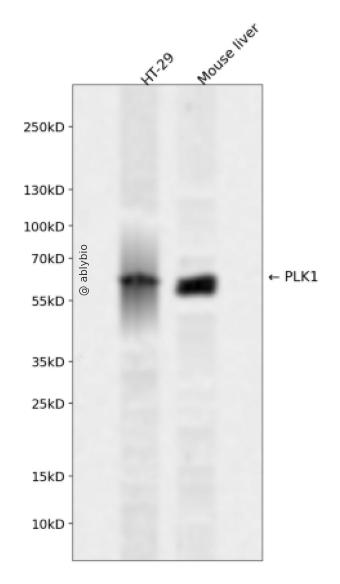
Western blot - PLK1 Rabbit pAb
Western blot analysis of PLK1 expressed in HT-29,Mouse liver using PLK1 Rabbit pAb at 1:1000. Secondary antibody: HRP Goat Anti-Rabbit IgG (H+L) at 1:5000. Lysates/proteins: 30ug per lane. Blocking buffer: 5% non-fat dry milk in TBST. Detection: ECL Enhanced Kit. Exposure time: 120s.
产品信息
应用指南
相关产品
抗原信息
靶点信息
资料与支持
实验步骤
常见问题
| 反应 | Human,Mouse,Rat |
|---|---|
| 宿主 | Rabbit |
| 克隆性 | Polyclonal |
| 同种型 | IgG |
| 预测反应 | WB: Homo sapiens IHC: Homo sapiens IF: Mus musculus , Homo sapiens |
| 应用 | WBIHCIF/ICC |
| 推荐浓度 | WB: 1:500 - 1:1000 IHC: 1:50 - 1:200 IF/ICC: 1:50 - 1:200 |
| 理论分子量 | 68kDa |
| 实测分子量 | 62KDa |
| 形式 | Liquid |
| 保存条件 | Store at -20℃. Avoid freeze / thaw cycles. Buffer: PBS with 0.02% sodium azide,50% glycerol,pH7.3. |
| 偶联物 | Unconjugated |
| 阳性对照 | HT-29,Mouse liver |
| 细胞定位 | Chromosome,Cytoplasm,Midbody,Nucleus,centromere,centrosome,cytoskeleton,kinetochore,microtubule organizing center,spindle |
| 纯化 | Affinity purification |
应用与推荐条件
快速判断怎么用
以下条件基于推荐浓度、验证图说明与通用实验要求整理,可作为预实验起点;不同样本和检测体系建议做梯度优化。
WB
WB 推荐条件
| 推荐稀释 | 1:500 - 1:1000 |
|---|---|
| 建议样本/阳性对照 | HT-29,Mouse liver |
| 关键条件 | 建议使用新鲜裂解样本,按推荐稀释比例孵育一抗,并关注理论/实测分子量 |
| 预期结果 | 预期信号/条带约 62KDa |
| 对照设置 | 建议设置阳性样本、阴性样本和二抗/同型对照 |
IHC
IHC 推荐条件
| 推荐稀释 | 1:50 - 1:200 |
|---|---|
| 建议样本/阳性对照 | HT-29,Mouse liver |
| 关键条件 | 石蜡切片建议优化抗原修复液 pH、修复时间和一抗孵育条件 |
| 预期结果 | 预期定位:Chromosome,Cytoplasm,Midbody,Nucleus,centromere,centrosome,cytoskeleton,kinetochore,microtubule organizing center,spindle |
| 对照设置 | 建议设置阳性样本、阴性样本和二抗/同型对照 |
IF/ICC
IF/ICC 推荐条件
| 推荐稀释 | 1:50 - 1:200 |
|---|---|
| 建议样本/阳性对照 | HT-29,Mouse liver |
| 关键条件 | 建议优化固定、通透和封闭条件,并设置二抗空白对照 |
| 预期结果 | 预期荧光定位:Chromosome,Cytoplasm,Midbody,Nucleus,centromere,centrosome,cytoskeleton,kinetochore,microtubule organizing center,spindle |
| 对照设置 | 建议设置阳性样本、阴性样本和二抗/同型对照 |
相关产品
查找相关产品 >>
抗原信息
| 抗原信息 | Recombinant fusion protein containing a sequence corresponding to amino acids 304-603 of human PLK1 (NP_005021.2). |
|---|---|
| 序列 |
查看序列FFTSGYIPARLPITCLTIPPRFSIAPSSLDPSNRKPLTVLNKGLENPLPERPREKEEPVVRETGEVVDCHLSDMLQQLHSVNASKPSERGLVRQEEAEDPACIPIFWVSKWVDYSDKYGLGYQLCDNSVGVLFNDSTRLILYNDGDSLQYIERDGTESYLTVSSHPNSLMKKITLLKYFRNYMSEHLLKAGANITPREGDELARLPYLRTWFRTRSAIILHLSNGSVQINFFQDHTKLILCPLMAAVTYIDEKRDFRTYRLSLLEEYGCCKELASRLRYARTMVDKLLSSRSASNRLKAS |
靶点信息
| 研究背景 | The Ser/Thr protein kinase encoded by this gene belongs to the CDC5/Polo subfamily. It is highly expressed during mitosis and elevated levels are found in many different types of cancer. Depletion of this protein in cancer cells dramatically inhibited cell proliferation and induced apoptosis; hence, it is a target for cancer therapy. |
|---|---|
| 基因 ID | 5347 |
| 基因名 | PLK1 |
| Swiss | P53350 |
| 别名 | PLK1,PLK,STPK13,PLK1 Rabbit pAb,Polo-like kinase 1,Serine/threonine-protein kinase 13 |
| 组织表达 | Placenta and colon. |
| 功能 | Serine/threonine-protein kinase that performs several important functions throughout M phase of the cell cycle, including the regulation of centrosome maturation and spindle assembly, the removal of cohesins from chromosome arms, the inactivation of anaphase-promoting complex/cyclosome (APC/C) inhibitors, and the regulation of mitotic exit and cytokinesis. Polo-like kinase proteins acts by binding and phosphorylating proteins are that already phosphorylated on a specific motif recognized by the POLO box domains. Phosphorylates BORA, BUB1B/BUBR1, CCNB1, CDC25C, CEP55, ECT2, ERCC6L, FBXO5/EMI1, FOXM1, KIF20A/MKLP2, CENPU, NEDD1, NINL, NPM1, NUDC, PKMYT1/MYT1, KIZ, PPP1R12A/MYPT1, PRC1, RACGAP1/CYK4, SGO1, STAG2/SA2, TEX14, TOPORS, p73/TP73, TPT1, WEE1 and HNRNPU. Plays a key role in centrosome functions and the assembly of bipolar spindles by phosphorylating KIZ, NEDD1 and NINL. NEDD1 phosphorylation promotes subsequent targeting of the gamma-tubulin ring complex (gTuRC) to the centrosome, an important step for spindle formation. Phosphorylation of NINL component of the centrosome leads to NINL dissociation from other centrosomal proteins. Involved in mitosis exit and cytokinesis by phosphorylating CEP55, ECT2, KIF20A/MKLP2, CENPU, PRC1 and RACGAP1. Recruited at the central spindle by phosphorylating and docking PRC1 and KIF20A/MKLP2; creates its own docking sites on PRC1 and KIF20A/MKLP2 by mediating phosphorylation of sites subsequently recognized by the POLO box domains. Phosphorylates RACGAP1, thereby creating a docking site for the Rho GTP exchange factor ECT2 that is essential for the cleavage furrow formation. Promotes the central spindle recruitment of ECT2. Plays a central role in G2/M transition of mitotic cell cycle by phosphorylating CCNB1, CDC25C, FOXM1, CENPU, PKMYT1/MYT1, PPP1R12A/MYPT1 and WEE1. Part of a regulatory circuit that promotes the activation of CDK1 by phosphorylating the positive regulator CDC25C and inhibiting the negative regulators WEE1 and PKMYT1/MYT1. Also acts by mediating phosphorylation of cyclin-B1 (CCNB1) on centrosomes in prophase. Phosphorylates FOXM1, a key mitotic transcription regulator, leading to enhance FOXM1 transcriptional activity. Involved in kinetochore functions and sister chromatid cohesion by phosphorylating BUB1B/BUBR1, FBXO5/EMI1 and STAG2/SA2. PLK1 is high on non-attached kinetochores suggesting a role of PLK1 in kinetochore attachment or in spindle assembly checkpoint (SAC) regulation. Required for kinetochore localization of BUB1B. Regulates the dissociation of cohesin from chromosomes by phosphorylating cohesin subunits such as STAG2/SA2. Phosphorylates SGO1: required for spindle pole localization of isoform 3 of SGO1 and plays a role in regulating its centriole cohesion function. Mediates phosphorylation of FBXO5/EMI1, a negative regulator of the APC/C complex during prophase, leading to FBXO5/EMI1 ubiquitination and degradation by the proteasome. Acts as a negative regulator of p53 family members: phosphorylates TOPORS, leading to inhibit the sumoylation of p53/TP53 and simultaneously enhance the ubiquitination and subsequent degradation of p53/TP53. Phosphorylates the transactivation domain of the transcription factor p73/TP73, leading to inhibit p73/TP73-mediated transcriptional activation and pro-apoptotic functions. Phosphorylates BORA, and thereby promotes the degradation of BORA. Contributes to the regulation of AURKA function. Also required for recovery after DNA damage checkpoint and entry into mitosis. Phosphorylates MISP, leading to stabilization of cortical and astral microtubule attachments required for proper spindle positioning (PubMed:8991084, PubMed:11202906, PubMed:12207013, PubMed:12447691, PubMed:12524548, PubMed:12738781, PubMed:12852856, PubMed:12939256, PubMed:14532005, PubMed:14734534, PubMed:15070733, PubMed:15148369, PubMed:15469984, PubMed:16198290, PubMed:16247472, PubMed:16980960, PubMed:17081991, PubMed:17351640, PubMed:17376779, PubMed:17617734, PubMed:18174154, PubMed:18331714, PubMed:18418051, PubMed:18477460, PubMed:18521620, PubMed:18615013, PubMed:19160488, PubMed:19351716, PubMed:19468300, PubMed:19468302, PubMed:19473992, PubMed:19509060, PubMed:19597481, PubMed:23455478, PubMed:23509069). Together with MEIKIN, acts as a regulator of kinetochore function during meiosis I: required both for mono-orientation of kinetochores on sister chromosomes and protection of centromeric cohesin from separase-mediated cleavage (By similarity). Phosphorylates CEP68 and is required for its degradation (PubMed:25503564). Regulates nuclear envelope breakdown during prophase by phosphorylating DCTN1 resulting in its localization in the nuclear envelope (PubMed:20679239). Phosphorylates the heat shock transcription factor HSF1, promoting HSF1 nuclear translocation upon heat shock (PubMed:15661742). Phosphorylates HSF1 also in the early mitotic period; this phosphorylation regulates HSF1 localization to the spindle pole, the recruitment of the SCF(BTRC) ubiquitin ligase complex induicing HSF1 degradation, and hence mitotic progression (PubMed:18794143). Regulates mitotic progression by phosphorylating RIOK2 (PubMed:21880710). |
| 研究领域 |
|
资料与技术支持
验证数据
1 张验证图
页面顶部轮播可查看应用验证图,覆盖 WB / IHC / IF/ICC。
常见问题
当前页面标注应用包括 WB, IHC, IF/ICC,建议结合页面验证图和推荐稀释比例进行预实验优化。
可通过页面询价/留言入口提交货号和批号,技术支持会协助提供对应批次资料。
页面推荐条件可作为起始浓度,不同样本、固定方式和检测体系可能需要梯度优化。