
HSPA9 (YD36285) Rabbit mAb (货号:AYD16522)
A
小A
销售顾问

请使用微信扫一扫
添加顾问进行咨询
货号
AYD16522
靶点/基因
HSPA9/Hspa9
宿主
Rabbit
克隆性
Monoclonal
反应种属
Human, Mouse, Rat
应用
WB
暂无验证图
欢迎提交实验图片,或联系 技术支持 获取更多信息。
产品信息
应用指南
相关产品
抗原信息
靶点信息
资料与支持
实验步骤
常见问题
| 反应 | Human,Mouse,Rat |
|---|---|
| 宿主 | Rabbit |
| 克隆性 | Monoclonal |
| 同种型 | IgG |
| 应用 | WB |
| 推荐浓度 | |
| 理论分子量 | 74kDa/73kDa/74kDa |
| 实测分子量 | |
| 形式 | Liquid |
| 保存条件 | Store at -20℃. Avoid freeze / thaw cycles. Buffer: PBS with 0.75% BSA,50% glycerol,pH7.3. |
| 偶联物 | Unconjugated |
| 阳性对照 | |
| 细胞定位 | Mitochondrion, Nucleus, nucleolus, Cytoplasm, Mitochondrion matrix |
| 纯化 | 亲和纯化 |
应用与推荐条件
快速判断怎么用
以下条件基于推荐浓度、验证图说明与通用实验要求整理,可作为预实验起点;不同样本和检测体系建议做梯度优化。
WB
WB 推荐条件
| 推荐稀释 | 请参考验证图说明或咨询技术支持 |
|---|---|
| 建议样本/阳性对照 | 建议选择靶点高表达样本作为阳性对照 |
| 关键条件 | 建议使用新鲜裂解样本,按推荐稀释比例孵育一抗,并关注理论/实测分子量 |
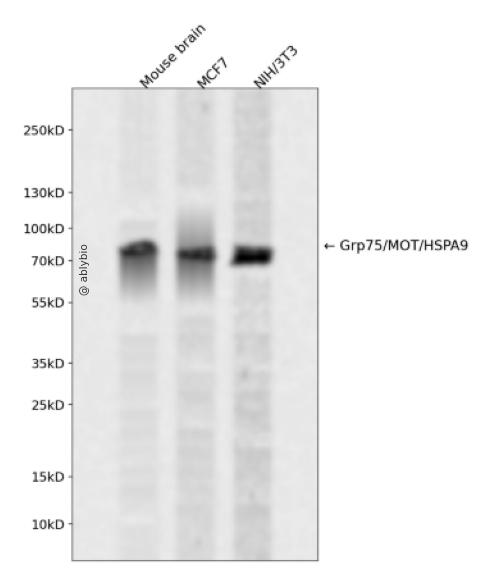
| 预期结果 | 预期信号/条带约 74kDa/73kDa/74kDa |
| 对照设置 | 建议设置阳性样本、阴性样本和二抗/同型对照 |
相关产品
查找相关产品 >>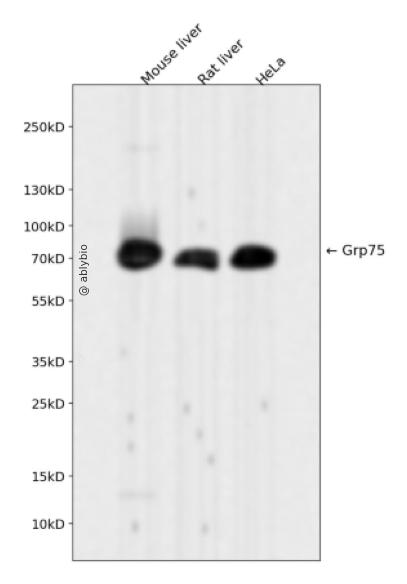
抗原信息
| 抗原信息 | 请咨询 技术支持 |
|---|---|
| 序列 | Email For Sequence |
靶点信息
| 研究背景 | Mitochondrial chaperone that plays a key role in mitochondrial protein import, folding, and assembly. Plays an essential role in the protein quality control system, the correct folding of proteins, the re-folding of misfolded proteins, and the targeting of proteins for subsequent degradation. These processes are achieved through cycles of ATP binding, ATP hydrolysis, and ADP release, mediated by co-chaperones (PubMed:18632665, PubMed:25615450, PubMed:28848044, PubMed:30933555, PubMed:31177526). In mitochondria, it associates with the TIM (translocase of the inner membrane) protein complex to assist in the import and folding of mitochondrial proteins (By similarity). Plays an important role in mitochondrial iron-sulfur cluster (ISC) biogenesis, interacts with and stabilizes ISC cluster assembly proteins FXN, NFU1, NFS1 and ISCU (PubMed:26702583). Regulates erythropoiesis via stabilization of ISC assembly (PubMed:21123823, PubMed:26702583). Regulates mitochondrial calcium-dependent apoptosis by coupling two calcium channels, ITPR1 and VDAC1, at the mitochondria-associated endoplasmic reticulum (ER) membrane to facilitate calcium transport from the ER lumen to the mitochondria intermembrane space, providing calcium for the downstream calcium channel MCU, which releases it into the mitochondrial matrix (By similarity). Although primarily located in the mitochondria, it is also found in other cellular compartments. In the cytosol, it associates with proteins involved in signaling, apoptosis, or senescence. It may play a role in cell cycle regulation via its interaction with and promotion of degradation of TP53 (PubMed:24625977, PubMed:26634371). May play a role in the control of cell proliferation and cellular aging (By similarity). Protects against reactive oxygen species (ROS) (By similarity). Extracellular HSPA9 plays a cytoprotective role by preventing cell lysis following immune attack by the membrane attack complex by disrupting formation of the complex (PubMed:16091382) Mitochondrial chaperone that plays a key role in mitochondrial protein import, folding, and assembly. Plays an essential role in the protein quality control system, the correct folding of proteins, the re-folding of misfolded proteins, and the targeting of proteins for subsequent degradation. These processes are achieved through cycles of ATP binding, ATP hydrolysis, and ADP release, mediated by co-chaperones. In mitochondria, it associates with the TIM (translocase of the inner membrane) protein complex to assist in the import and folding of mitochondrial proteins (By similarity). Plays an important role in mitochondrial iron-sulfur cluster (ISC) biogenesis (PubMed:26702583). Interacts with and stabilizes ISC cluster assembly proteins FXN, NFU1, NFS1 and ISCU (PubMed:21123823). Regulates erythropoiesis via stabilization of ISC assembly (PubMed:21123823). Regulates mitochondrial calcium-dependent apoptosis by coupling two calcium channels, ITPR1 and VDAC1, at the mitochondria-associated endoplasmic reticulum (ER) membrane to facilitate calcium transport from the ER lumen to the mitochondria intermembrane space, providing calcium for the downstream calcium channel MCU, which releases it into the mitochondrial matrix (PubMed:29907098). Although primarily located in the mitochondria, it is also found in other cellular compartments. In the cytosol, it associates with proteins involved in signaling, apoptosis, or senescence. It may play a role in cell cycle regulation via its interaction with and promotion of degradation of TP53 (By similarity). May play a role in the control of cell proliferation and cellular aging (PubMed:21123823, PubMed:26702583, PubMed:8454632). Protects against reactive oxygen species (ROS) (PubMed:24243970). Extracellular HSPA9 plays a cytoprotective role by preventing cell lysis following immune attack by the membrane attack complex by disrupting formation of the complex (By similarity) Mitochondrial chaperone that plays a key role in mitochondrial protein import, folding, and assembly. Plays an essential role in the protein quality control system, the correct folding of proteins, the re-folding of misfolded proteins, and the targeting of proteins for subsequent degradation. These processes are achieved through cycles of ATP binding, ATP hydrolysis, and ADP release, mediated by co-chaperones. In mitochondria, it associates with the TIM (translocase of the inner membrane) protein complex to assist in the import and folding of mitochondrial proteins (By similarity). Plays an important role in mitochondrial iron-sulfur cluster (ISC) biogenesis, interacts with and stabilizes ISC cluster assembly proteins FXN, NFU1, NFS1 and ISCU. Regulates erythropoiesis via stabilization of ISC assembly. Regulates mitochondrial calcium-dependent apoptosis by coupling two calcium channels, ITPR1 and VDAC1, at the mitochondria-associated endoplasmic reticulum (ER) membrane to facilitate calcium transport from the ER lumen to the mitochondria intermembrane space, providing calcium for the downstream calcium channel MCU, which releases it into the mitochondrial matrix (By similarity). Although primarily located in the mitochondria, it is also found in other cellular compartments. In the cytosol, it associates with proteins involved in signaling, apoptosis, or senescence. It may play a role in cell cycle regulation via its interaction with and promotion of degradation of TP53 (By similarity). May play a role in the control of cell proliferation and cellular aging (By similarity). Protects against reactive oxygen species (ROS) (By similarity). Extracellular HSPA9 plays a cytoprotective role by preventing cell lysis following immune attack by the membrane attack complex by disrupting formation of the complex (By similarity) |
|---|---|
| 基因 ID | 3313 |
| 基因名 | HSPA9, Hspa9 |
| Swiss | P38646, P38647, P48721 |
| 别名 | HSPA9 (YD36285),HSPA9 (YD36285) Rabbit mAb,HSPA9,75 kDa glucose-regulated protein,Heat shock 70 kDa protein 9,Heat shock protein family A member 9,Mortalin,Peptide-binding protein 74,p66 MOT,mtHSP70,GRP75,HSPA9B,mt-HSP70,Hsp74,Hspa9a |
资料与技术支持
验证数据
欢迎联系技术支持获取验证图与应用案例。
常见问题
当前页面标注应用包括 WB,建议结合页面验证图和推荐稀释比例进行预实验优化。
可通过页面询价/留言入口提交货号和批号,技术支持会协助提供对应批次资料。
页面推荐条件可作为起始浓度,不同样本、固定方式和检测体系可能需要梯度优化。