
NMDAR2B (YD35507) Rabbit mAb (Cat.#:AYD16566)
小A
Sales advisor

Scan with WeChat to add an advisor
暂无验证图
欢迎提交实验图片,或联系 Support 获取更多信息。
Cat.#:AYD16566
| Size | Price | |
|---|---|---|
| 50ul | RMB: 680Sale1280 | Add to cart |
| 100ul | RMB: 1219Sale2300 | Add to cart |
Sales Terms | Request COA | Stock and shipping are confirmed by support
Information
Application guide
Related products
Immunogen
Target data
Resources
Protocols
FAQs
| Reactivity | Human, Mouse, Rat |
|---|---|
| Host | Rabbit |
| Clonality | Monoclonal |
| Isotype | IgG |
| Application | WBIHC-PIP |
| Dilution | |
| Predicted MW | 166kDa/166kDa/166kDa |
| Observed MW | |
| Format | Liquid |
| Storage | Store at -20℃. Avoid freeze / thaw cycles. Buffer: PBS with 0.75% BSA,50% glycerol,pH7.3. |
| Conjugate | Unconjugated |
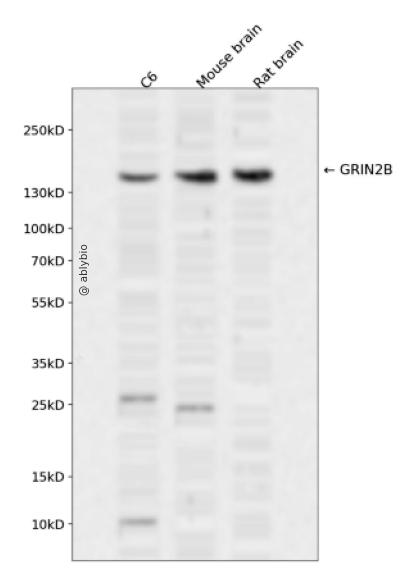
| Positive | C6,Mouse brain,Rat brain |
| Subcellular | Cell membrane, Postsynaptic cell membrane, Cell projection, dendrite, Late endosome, Lysosome, Cytoplasm, cytoskeleton |
| Purification | 亲和纯化 |
Applications and conditions
These starting conditions come from the recommended dilution, validation images, and general assay practice. Titrate for your sample and detection system.
| Recommended dilution | See the validation images or contact technical support |
|---|---|
| Suggested sample / positive control | C6,Mouse brain,Rat brain |
| Key conditions | Use a fresh lysate, incubate at the recommended dilution, and check the predicted and observed molecular weight |
| Expected result | Expected signal or band near 166kDa/166kDa/166kDa |
| Controls | Include a positive sample, a negative sample, and a secondary or isotype control |
| Recommended dilution | See the validation images or contact technical support |
|---|---|
| Suggested sample / positive control | C6,Mouse brain,Rat brain |
| Key conditions | For paraffin sections, optimize retrieval buffer pH, retrieval time, and primary incubation |
| Expected result | Expected localization: Cell membrane, Postsynaptic cell membrane, Cell projection, dendrite, Late endosome, Lysosome, Cytoplasm, cytoskeleton |
| Controls | Include a positive sample, a negative sample, and a secondary or isotype control |
| Recommended dilution | See the validation images or contact technical support |
|---|---|
| Suggested sample / positive control | C6,Mouse brain,Rat brain |
| Key conditions | Start at the recommended dilution and titrate for your sample and assay |
| Expected result | Expected signal or band near 166kDa/166kDa/166kDa |
| Controls | Include a positive sample, a negative sample, and a secondary or isotype control |
Related products
More associated products >>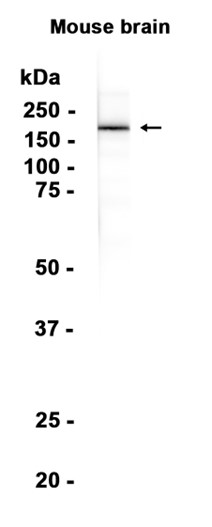
Immunogen
| Immunogen | Please contact Support |
|---|---|
| Sequence | Request sequence |
Target data
| Background | Component of N-methyl-D-aspartate (NMDA) receptors (NMDARs) that function as heterotetrameric, ligand-gated cation channels with high calcium permeability and voltage-dependent block by Mg(2+) (PubMed:24272827, PubMed:24863970, PubMed:26875626, PubMed:26919761, PubMed:27839871, PubMed:28095420, PubMed:28126851, PubMed:38538865, PubMed:8768735). Participates in synaptic plasticity for learning and memory formation by contributing to the long-term depression (LTD) of hippocampus membrane currents (By similarity). Channel activation requires binding of the neurotransmitter L-glutamate to the GluN2 subunit, glycine or D-serine binding to the GluN1 subunit, plus membrane depolarization to eliminate channel inhibition by Mg(2+) (PubMed:24272827, PubMed:24863970, PubMed:26875626, PubMed:26919761, PubMed:27839871, PubMed:28095420, PubMed:28126851, PubMed:38538865, PubMed:8768735). NMDARs mediate simultaneously the potassium efflux and the influx of calcium and sodium (By similarity). Each GluN2 subunit confers differential attributes to channel properties, including activation, deactivation and desensitization kinetics, pH sensitivity, Ca2(+) permeability, and binding to allosteric modulators (PubMed:26875626, PubMed:28095420, PubMed:28126851, PubMed:38538865, PubMed:8768735). In concert with DAPK1 at extrasynaptic sites, acts as a central mediator for stroke damage. Its phosphorylation at Ser-1303 by DAPK1 enhances synaptic NMDA receptor channel activity inducing injurious Ca2+ influx through them, resulting in an irreversible neuronal death (By similarity) Component of N-methyl-D-aspartate (NMDA) receptors (NMDARs) that function as heterotetrameric, ligand-gated cation channels with high calcium permeability and voltage-dependent block by Mg(2+) (PubMed:26912815). Participates in synaptic plasticity for learning and memory formation by contributing to the long-term depression (LTD) of hippocampus membrane currents (PubMed:8789948). Channel activation requires binding of the neurotransmitter L-glutamate to the GluN2 subunit, glycine or D-serine binding to the GluN1 subunit, plus membrane depolarization to eliminate channel inhibition by Mg(2+) (Probable) (PubMed:1377365, PubMed:20141836, PubMed:7790891). NMDARs mediate simultaneously the potassium efflux and the influx of calcium and sodium (By similarity). Each GluN2 subunit confers differential attributes to channel properties, including activation, deactivation and desensitization kinetics, pH sensitivity, Ca2(+) permeability, and binding to allosteric modulators (By similarity). In concert with DAPK1 at extrasynaptic sites, acts as a central mediator for stroke damage (PubMed:20141836). Its phosphorylation at Ser-1303 by DAPK1 enhances synaptic NMDA receptor channel activity inducing injurious Ca2+ influx through them, resulting in an irreversible neuronal death (PubMed:20141836) Component of N-methyl-D-aspartate (NMDA) receptors (NMDARs) that function as heterotetrameric, ligand-gated cation channels with high calcium permeability and voltage-dependent block by Mg(2+) (PubMed:11929923, PubMed:19910922, PubMed:21677647, PubMed:24607230, PubMed:24876489, PubMed:27135925, PubMed:7524561). Participates in synaptic plasticity for learning and memory formation by contributing to the long-term depression (LTD) of hippocampus membrane currents (By similarity). Channel activation requires binding of the neurotransmitter L-glutamate to the GluN2 subunit, glycine or D-serine binding to the GluN1 subunit, plus membrane depolarization to eliminate channel inhibition by Mg(2+) (PubMed:11929923, PubMed:19910922, PubMed:21677647, PubMed:24607230, PubMed:24876489, PubMed:27135925, PubMed:7524561). NMDARs mediate simultaneously the potassium efflux and the influx of calcium and sodium (By similarity). Each GluN2 subunit confers differential attributes to channel properties, including activation, deactivation and desensitization kinetics, pH sensitivity, Ca2(+) permeability, and binding to allosteric modulators (PubMed:10436042, PubMed:11929923, PubMed:24607230, PubMed:9463421). In concert with DAPK1 at extrasynaptic sites, acts as a central mediator for stroke damage (By similarity). Its phosphorylation at Ser-1303 by DAPK1 enhances synaptic NMDA receptor channel activity inducing injurious Ca2+ influx through them, resulting in an irreversible neuronal death (By similarity) |
|---|---|
| Gene ID | 2904 |
| Gene name | GRIN2B, Grin2b |
| Swiss | Q13224, Q01097, Q00960 |
| Synonym | NMDAR2B (YD35507),NMDAR2B (YD35507) Rabbit mAb,GRIN2B,Glutamate [NMDA] receptor subunit epsilon-2,N-methyl D-aspartate receptor subtype 2B,N-methyl-D-aspartate receptor subunit 3,NMDAR2B |
Resources
Validation data
Contact technical support for validation images and application examples.
References
No papers are linked yet. Contact technical support for application examples.
Ask for examplesCustomer reviews
No reviews yet. After use, you can submit a review and experiment images.
Send feedbackSupport
Support can help confirm the application, sample, dilution, controls, and assay conditions.
Support centerSend the catalog number, application, sample type, and assay. Support can confirm dilution, controls, and COA or lot documents.