
NLRP3 (YD32564) Rabbit mAb (Cat.#:AYD13439)
小A
Sales advisor

Scan with WeChat to add an advisor
Cat.#:AYD13439
| Size | Price | |
|---|---|---|
| 50ul | RMB: 680Sale1280 | Add to cart |
| 100ul | RMB: 1219Sale2300 | Add to cart |
Sales Terms | Request COA | Stock and shipping are confirmed by support
Information
Application guide
Related products
Immunogen
Target data
Resources
Protocols
FAQs
| Reactivity | Human,Mouse,Rat |
|---|---|
| Host | Rabbit |
| Clonality | Monoclonal |
| Isotype | IgG |
| Application | WBFCIP |
| Dilution | WB: 1:1000-1:3000: FC: 1:20-1:50: IP: 1:20-1:50: |
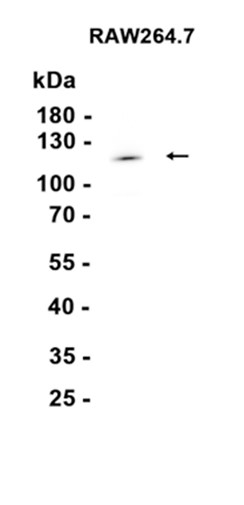
| Predicted MW | 118kDa |
| Observed MW | 118 kDa |
| Format | Liquid |
| Storage | Store at -20℃. Avoid freeze / thaw cycles. Buffer: PBS with 0.75% BSA,50% glycerol,pH7.3. |
| Conjugate | Unconjugated |
| Positive | Macrophage |
| Subcellular | Cytoplasm, cytosol, Inflammasome, cytoskeleton, microtubule organizing center, Golgi apparatus membrane, Endoplasmic reticulum, Mitochondrion, Secreted, Nucleus |
| Purification | 亲和纯化 |
Applications and conditions
These starting conditions come from the recommended dilution, validation images, and general assay practice. Titrate for your sample and detection system.
| Recommended dilution | See the validation images or contact technical support |
|---|---|
| Suggested sample / positive control | Macrophage |
| Key conditions | Use a fresh lysate, incubate at the recommended dilution, and check the predicted and observed molecular weight |
| Expected result | Expected signal or band near 118 kDa |
| Controls | Include a positive sample, a negative sample, and a secondary or isotype control |
| Recommended dilution | See the validation images or contact technical support |
|---|---|
| Suggested sample / positive control | Macrophage |
| Key conditions | For intracellular targets, optimize fixation and permeabilization, and include an isotype control |
| Expected result | Expect the positive population to shift relative to the negative or isotype control |
| Controls | Include a positive sample, a negative sample, and a secondary or isotype control |
| Recommended dilution | See the validation images or contact technical support |
|---|---|
| Suggested sample / positive control | Macrophage |
| Key conditions | Start at the recommended dilution and titrate for your sample and assay |
| Expected result | Expected signal or band near 118 kDa |
| Controls | Include a positive sample, a negative sample, and a secondary or isotype control |
Related products
More associated products >>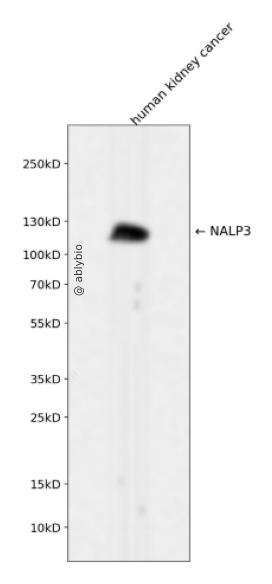
Immunogen
| Immunogen | Please contact Support |
|---|---|
| Sequence | Request sequence |
Target data
| Background | Sensor component of the NLRP3 inflammasome, which mediates inflammasome activation in response to defects in membrane integrity, leading to secretion of inflammatory cytokines IL1B and IL18 and pyroptosis (PubMed:16407889, PubMed:18403674, PubMed:18604214, PubMed:23582325, PubMed:25686105, PubMed:27929086, PubMed:28656979, PubMed:28847925, PubMed:30487600, PubMed:30612879, PubMed:31086327, PubMed:31086329, PubMed:31189953, PubMed:33231615, PubMed:34133077, PubMed:34341353, PubMed:34512673, PubMed:36442502, PubMed:40450990). In response to pathogens and other damage-associated signals that affect the integrity of membranes, initiates the formation of the inflammasome polymeric complex composed of NLRP3, CASP1 and PYCARD/ASC (PubMed:16407889, PubMed:18403674, PubMed:27432880, PubMed:28847925, PubMed:31189953, PubMed:33231615, PubMed:34133077, PubMed:34341353, PubMed:36142182, PubMed:36442502). Recruitment of pro-caspase-1 (proCASP1) to the NLRP3 inflammasome promotes caspase-1 (CASP1) activation, which subsequently cleaves and activates inflammatory cytokines IL1B and IL18 and gasdermin-D (GSDMD), promoting cytokine secretion and pyroptosis (PubMed:23582325, PubMed:28847925, PubMed:31189953, PubMed:33231615, PubMed:34133077, PubMed:34341353). Activation of NLRP3 inflammasome is also required for HMGB1 secretion; stimulating inflammatory responses (PubMed:22801494). Involved in the homeostatic wound healing response to tissue injury, a multistep cascade that guides neutrophil migration to necrotic sites while avoiding collateral damage of healthy tissues. ATP released from necrotic cells triggers activation of NLRP3 inflammasome through P2RX7 signaling leading to neutrophil adhesion to the vascular endothelium close to the injury site (By similarity). Under resting conditions, ADP-bound NLRP3 is autoinhibited (PubMed:35114687). NLRP3 activation stimuli include extracellular ATP, nigericin, reactive oxygen species, crystals of monosodium urate or cholesterol, amyloid-beta fibers, environmental or industrial particles and nanoparticles, such as asbestos, silica, aluminum salts, cytosolic dsRNA, etc (PubMed:16407889, PubMed:18403674, PubMed:18604214, PubMed:19414800, PubMed:23871209). Almost all stimuli trigger intracellular K(+) efflux (By similarity). These stimuli lead to membrane perturbation and activation of NLRP3 (By similarity). Upon activation, NLRP3 is transported to microtubule organizing center (MTOC), where it is unlocked by NEK7, leading to its relocalization to dispersed trans-Golgi network (dTGN) vesicle membranes and formation of an active inflammasome complex (PubMed:36442502, PubMed:39173637). Associates with dTGN vesicle membranes by binding to phosphatidylinositol 4-phosphate (PtdIns4P) (PubMed:30487600, PubMed:34554188). Shows ATPase activity (PubMed:17483456) |
|---|---|
| Gene ID | 114548 |
| Gene name | NLRP3 |
| Swiss | Q96P20 |
| Synonym | NLRP3 (YD32564),NLRP3 (YD32564) Rabbit mAb,NLRP3,Angiotensin/vasopressin receptor AII/AVP-like,Caterpiller protein 1.1,Cold-induced autoinflammatory syndrome 1 protein,Cryopyrin,PYRIN-containing APAF1-like protein 1,C1orf7 |
Resources
Validation data
1 images
Validation images at the top of the page cover WB / FC / IP.
References
No papers are linked yet. Contact technical support for application examples.
Ask for examplesCustomer reviews
No reviews yet. After use, you can submit a review and experiment images.
Send feedbackSupport
Support can help confirm the application, sample, dilution, controls, and assay conditions.
Support centerSend the catalog number, application, sample type, and assay. Support can confirm dilution, controls, and COA or lot documents.