
MADD Antibody (Cat.#:AYP5399)
小A
Sales advisor

Scan with WeChat to add an advisor
暂无验证图
欢迎提交实验图片,或联系 Support 获取更多信息。
Cat.#:AYP5399
| Size | Price | |
|---|---|---|
| 50 μL | ¥1150.00 | Add to cart |
| 100 μL | ¥2100.00 | Add to cart |
Sales Terms | Request COA | Stock and shipping are confirmed by support
Information
Application guide
Related products
Immunogen
Target data
Resources
Protocols
FAQs
| Reactivity | Human,Mouse,Rat |
|---|---|
| Host | Rabbit |
| Clonality | Polyclonal |
| Isotype | IgG |
| Application | WBIHCIFELISA |
| Dilution | WB: 1:500 - 1:2000 IHC: 1:50 - 1:200 IF: 1:50 - 1:200 |
| Predicted MW | |
| Observed MW | |
| Format | Liquid |
| Storage | Store at -20℃. Avoid freeze / thaw cycles. Buffer: PBS with 0.75% BSA,50% glycerol,pH7.3. |
| Conjugate | Unconjugated |
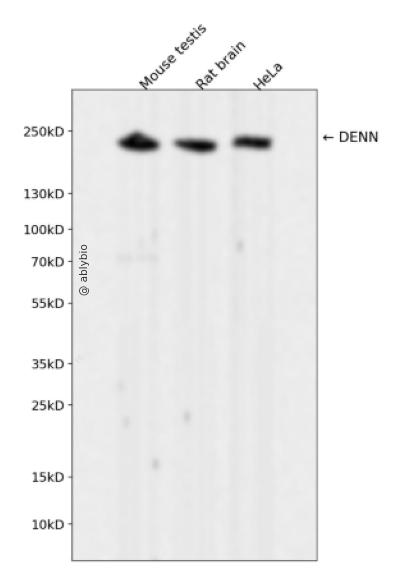
| Positive | HeLa,SH-SY5Y,Mouse testis,Rat brain |
| Subcellular | axon,cytoplasm,cytosol,plasma membrane |
| Purification | Affinity purification |
Applications and conditions
These starting conditions come from the recommended dilution, validation images, and general assay practice. Titrate for your sample and detection system.
| Recommended dilution | 1:500 - 1:2000 |
|---|---|
| Suggested sample / positive control | HeLa,SH-SY5Y,Mouse testis,Rat brain |
| Key conditions | Use a fresh lysate, incubate at the recommended dilution, and check the predicted and observed molecular weight |
| Expected result | Expected signal follows target localization and the validation images |
| Controls | Include a positive sample, a negative sample, and a secondary or isotype control |
| Recommended dilution | 1:50 - 1:200 |
|---|---|
| Suggested sample / positive control | HeLa,SH-SY5Y,Mouse testis,Rat brain |
| Key conditions | For paraffin sections, optimize retrieval buffer pH, retrieval time, and primary incubation |
| Expected result | Expected localization: axon,cytoplasm,cytosol,plasma membrane |
| Controls | Include a positive sample, a negative sample, and a secondary or isotype control |
| Recommended dilution | 1:50 - 1:200 |
|---|---|
| Suggested sample / positive control | HeLa,SH-SY5Y,Mouse testis,Rat brain |
| Key conditions | Optimize fixation, permeabilization, and blocking, and include a secondary-only control |
| Expected result | Expected fluorescence localization: axon,cytoplasm,cytosol,plasma membrane |
| Controls | Include a positive sample, a negative sample, and a secondary or isotype control |
| Recommended dilution | See the validation images or contact technical support |
|---|---|
| Suggested sample / positive control | HeLa,SH-SY5Y,Mouse testis,Rat brain |
| Key conditions | Start at the recommended dilution and titrate for your sample and assay |
| Expected result | Expected signal follows target localization and the validation images |
| Controls | Include a positive sample, a negative sample, and a secondary or isotype control |
Related products
More associated products >>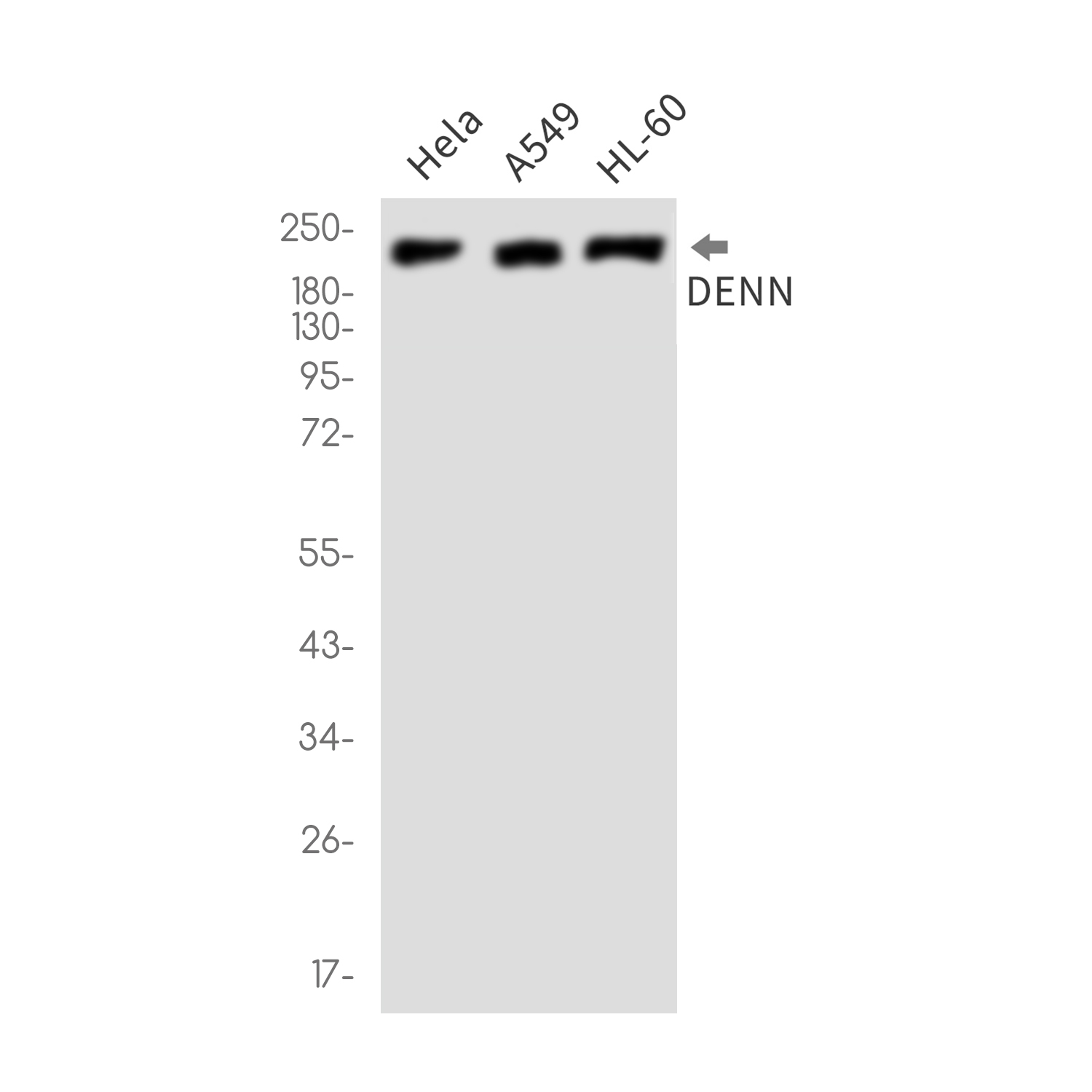
Immunogen
| Immunogen | Synthesized peptide derived from Human MADD. |
|---|---|
| Sequence |
View sequenceVQDLKTGEGGLLQVTLEGINLKFMHNQVFIELNHIKKCNTVRGVFVLEEFVPEIKEVVSHKYKTPMAHEICYSVLCLFSYVAAVHSSEEDLRTPPRPVSS |
Target data
| Background | Tumor necrosis factor alpha (TNF-alpha) is a signaling molecule that interacts with one of two receptors on cells targeted for apoptosis. The apoptotic signal is transduced inside these cells by cytoplasmic adaptor proteins. The protein encoded by this gene is a death domain-containing adaptor protein that interacts with the death domain of TNF-alpha receptor 1 to activate mitogen-activated protein kinase (MAPK) and propagate the apoptotic signal. It is membrane-bound and expressed at a higher level in neoplastic cells than in normal cells. Several transcript variants encoding different isoforms have been described for this gene. [provided by RefSeq, Jul 2008] |
|---|---|
| Gene ID | 8567 |
| Gene name | MADD |
| Swiss | Q8WXG6 |
| Synonym | MADD Antibody,MADD,Differentially expressed in normal and neoplastic cells,Insulinoma glucagonoma clone 20,Rab3 GDP/GTP exchange factor,Rab3 GDP/GTP exchange protein,DENN |
| Expression | Expressed in testis, ovary, brain and heart (PubMed:8988362). Expressed in spleen, thymus, prostate, testis, ovary, small instestine and colon (PubMed:9115275). Expressed in liver (PubMed:9796103).; [Isoform 1]: Not detected in the brain, breast, kidney, lung, ovary, pancreas, testis, uterus, stomach and thyroid.; [Isoform 2]: Expressed in the brain, breast, kidney, lung, ovary, pancreas, testis, uterus, stomach and thyroid.; [Isoform 3]: Expressed in the brain, breast, kidney, lung, ovary, pancreas, testis, uterus, stomach and thyroid.; [Isoform 4]: Expressed in the brain, breast, kidney, lung, ovary, pancreas, testis, uterus, stomach and thyroid.; [Isoform 5]: Expressed in the brain, breast, kidney, lung, ovary, pancreas, testis, uterus, stomach and thyroid.; [Isoform 6]: Not detected in the brain, breast, kidney, lung, ovary, pancreas, testis, uterus, stomach and thyroid.; [Isoform 7]: Not detected in the brain, breast, kidney, lung, ovary, pancreas, testis, uterus, stomach and thyroid. |
| Functions | Plays a significant role in regulating cell proliferation, survival and death through alternative mRNA splicing. Isoform 5 shows increased cell proliferation and isoform 2 shows decreased. Converts GDP-bound inactive form of RAB3A, RAB3C and RAB3D to the GTP-bound active forms. Component of the TNFRSF1A signaling complex: MADD links TNFRSF1A with MAP kinase activation. Plays an important regulatory role in physiological cell death (TNF-alpha-induced, caspase-mediated apoptosis); isoform 1 is susceptible to inducing apoptosis, isoform 5 is resistant and isoform 3 and isoform 4 have no effect. |
| Research area |
Resources
Validation data
Contact technical support for validation images and application examples.
References
No papers are linked yet. Contact technical support for application examples.
Ask for examplesCustomer reviews
No reviews yet. After use, you can submit a review and experiment images.
Send feedbackSupport
Support can help confirm the application, sample, dilution, controls, and assay conditions.
Support centerSend the catalog number, application, sample type, and assay. Support can confirm dilution, controls, and COA or lot documents.