
FMR1 (YD11295) Rabbit mAb (Cat.#:AYD16527)
小A
Sales advisor

Scan with WeChat to add an advisor
暂无验证图
欢迎提交实验图片,或联系 Support 获取更多信息。
Cat.#:AYD16527
| Size | Price | |
|---|---|---|
| 50ul | RMB: 680Sale1280 | Add to cart |
| 100ul | RMB: 1219Sale2300 | Add to cart |
Sales Terms | Request COA | Stock and shipping are confirmed by support
Information
Application guide
Related products
Immunogen
Target data
Resources
Protocols
FAQs
| Reactivity | Human, Mouse |
|---|---|
| Host | Rabbit |
| Clonality | Monoclonal |
| Isotype | IgG |
| Application | WB |
| Dilution | |
| Predicted MW | 71kDa/69kDa |
| Observed MW | |
| Format | Liquid |
| Storage | Store at -20℃. Avoid freeze / thaw cycles. Buffer: PBS with 0.75% BSA,50% glycerol,pH7.3. |
| Conjugate | Unconjugated |
| Positive | Brain,Cerebellum,Testis |
| Subcellular | Cytoplasm, Cytoplasmic ribonucleoprotein granule, Stress granule, Perikaryon, perinuclear region, Cell projection, neuron projection, axon, dendrite, dendritic spine, Synapse, synaptosome, growth cone, filopodium tip, Postsynaptic cell membrane, Presynaptic cell membrane, Nucleus, nucleolus, Chromosome, centromere, Cell membrane, Cajal body, filopodium, nucleoplasm |
| Purification | 亲和纯化 |
Applications and conditions
These starting conditions come from the recommended dilution, validation images, and general assay practice. Titrate for your sample and detection system.
| Recommended dilution | See the validation images or contact technical support |
|---|---|
| Suggested sample / positive control | Brain,Cerebellum,Testis |
| Key conditions | Use a fresh lysate, incubate at the recommended dilution, and check the predicted and observed molecular weight |
| Expected result | Expected signal or band near 71kDa/69kDa |
| Controls | Include a positive sample, a negative sample, and a secondary or isotype control |
Related products
More associated products >>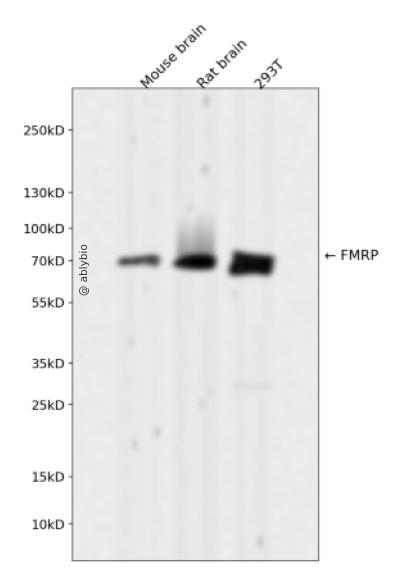
Immunogen
| Immunogen | Please contact Support |
|---|---|
| Sequence | Request sequence |
Target data
| Background | Multifunctional polyribosome-associated RNA-binding protein that plays a central role in neuronal development and synaptic plasticity through the regulation of alternative mRNA splicing, mRNA stability, mRNA dendritic transport and postsynaptic local protein synthesis of target mRNAs (PubMed:12417522, PubMed:16631377, PubMed:18653529, PubMed:19166269, PubMed:23235829, PubMed:25464849). Acts as an mRNA regulator by mediating formation of some phase-separated membraneless compartment: undergoes liquid-liquid phase separation upon binding to target mRNAs, leading to assemble mRNAs into cytoplasmic ribonucleoprotein granules that concentrate mRNAs with associated regulatory factors (PubMed:12417522, PubMed:30765518, PubMed:31439799). Plays a role in the alternative splicing of its own mRNA (PubMed:18653529). Stabilizes the scaffolding postsynaptic density protein DLG4/PSD-95 and the myelin basic protein (MBP) mRNAs in hippocampal neurons and glial cells, respectively; this stabilization is further increased in response to metabotropic glutamate receptor (mGluR) stimulation (By similarity). Plays a role in selective delivery of a subset of dendritic mRNAs to synaptic sites in response to mGluR activation in a kinesin-dependent manner (By similarity). Undergoes liquid-liquid phase separation following phosphorylation and interaction with CAPRIN1, promoting formation of cytoplasmic ribonucleoprotein granules that concentrate mRNAs with factors that inhibit translation and mediate deadenylation of target mRNAs (PubMed:31439799). Acts as a repressor of mRNA translation in synaptic regions by mediating formation of neuronal ribonucleoprotein granules and promoting recruitmtent of EIF4EBP2 (PubMed:30765518). Plays a role as a repressor of mRNA translation during the transport of dendritic mRNAs to postsynaptic dendritic spines (PubMed:11157796, PubMed:11532944, PubMed:12594214, PubMed:23235829). Component of the CYFIP1-EIF4E-FMR1 complex which blocks cap-dependent mRNA translation initiation (By similarity). Represses mRNA translation by stalling ribosomal translocation during elongation (By similarity). Reports are contradictory with regards to its ability to mediate translation inhibition of MBP mRNA in oligodendrocytes (PubMed:23891804). Also involved in the recruitment of the RNA helicase MOV10 to a subset of mRNAs and hence regulates microRNA (miRNA)-mediated translational repression by AGO2 (PubMed:14703574, PubMed:17057366, PubMed:25464849). Facilitates the assembly of miRNAs on specific target mRNAs (PubMed:17057366). Also plays a role as an activator of mRNA translation of a subset of dendritic mRNAs at synapses (PubMed:19097999, PubMed:19166269). In response to mGluR stimulation, FMR1-target mRNAs are rapidly derepressed, allowing for local translation at synapses (By similarity). Binds to a large subset of dendritic mRNAs that encode a myriad of proteins involved in pre- and postsynaptic functions (PubMed:11157796, PubMed:11719189, PubMed:12594214, PubMed:17417632, PubMed:23235829, PubMed:24448548, PubMed:7692601). Binds to 5'-ACU[GU]-3' and/or 5'-[AU]GGA-3' RNA consensus sequences within mRNA targets, mainly at coding sequence (CDS) and 3'-untranslated region (UTR) and less frequently at 5'-UTR (PubMed:23235829). Binds to intramolecular G-quadruplex structures in the 5'- or 3'-UTRs of mRNA targets (PubMed:11719189, PubMed:18579868, PubMed:25464849, PubMed:25692235). Binds to G-quadruplex structures in the 3'-UTR of its own mRNA (PubMed:11532944, PubMed:12594214, PubMed:15282548, PubMed:18653529, PubMed:7692601). Also binds to RNA ligands harboring a kissing complex (kc) structure; this binding may mediate the association of FMR1 with polyribosomes (PubMed:15805463). Binds mRNAs containing U-rich target sequences (PubMed:12927206). Binds to a triple stem-loop RNA structure, called Sod1 stem loop interacting with FMRP (SoSLIP), in the 5'-UTR region of superoxide dismutase SOD1 mRNA (PubMed:19166269). Binds to the dendritic, small non-coding brain cytoplasmic RNA 1 (BC1); which may increase the association of the CYFIP1-EIF4E-FMR1 complex to FMR1 target mRNAs at synapses (By similarity). Plays a role in mRNA nuclear export (PubMed:31753916). Specifically recognizes and binds a subset of N6-methyladenosine (m6A)-containing mRNAs, promoting their nuclear export in a XPO1/CRM1-dependent manner (PubMed:31753916). Together with export factor NXF2, is involved in the regulation of the NXF1 mRNA stability in neurons (By similarity). Associates with export factor NXF1 mRNA-containing ribonucleoprotein particles (mRNPs) in a NXF2-dependent manner (By similarity). Binds to a subset of miRNAs in the brain (PubMed:14703574, PubMed:17057366). May associate with nascent transcripts in a nuclear protein NXF1-dependent manner (PubMed:18936162). In vitro, binds to RNA homomer; preferentially on poly(G) and to a lesser extent on poly(U), but not on poly(A) or poly(C) (PubMed:12950170, PubMed:15381419, PubMed:7688265, PubMed:7781595, PubMed:8156595). Moreover, plays a role in the modulation of the sodium-activated potassium channel KCNT1 gating activity (PubMed:20512134). Negatively regulates the voltage-dependent calcium channel current density in soma and presynaptic terminals of dorsal root ganglion (DRG) neurons, and hence regulates synaptic vesicle exocytosis (By similarity). Modulates the voltage-dependent calcium channel CACNA1B expression at the plasma membrane by targeting the channels for proteasomal degradation (By similarity). Plays a role in regulation of MAP1B-dependent microtubule dynamics during neuronal development (By similarity). Has been shown to play a translation-independent role in the modulation of presynaptic action potential (AP) duration and neurotransmitter release via large-conductance calcium-activated potassium (BK) channels in hippocampal and cortical excitatory neurons (PubMed:25561520). May be involved in the control of DNA damage response (DDR) mechanisms through the regulation of ATR-dependent signaling pathways such as histone H2AX/H2A.x and BRCA1 phosphorylations (PubMed:24813610). Forms a cytoplasmic messenger ribonucleoprotein (mRNP) network by packaging long mRNAs, serving as a scaffold that recruits proteins and signaling molecules. This network facilitates signaling reactions by maintaining proximity between kinases and substrates (PubMed:39106863) Multifunctional polyribosome-associated RNA-binding protein that plays a central role in neuronal development and synaptic plasticity through the regulation of alternative mRNA splicing, mRNA stability, mRNA dendritic transport and postsynaptic local protein synthesis of target mRNAs (PubMed:11438589, PubMed:12032354, PubMed:15475576, PubMed:16631377, PubMed:16790844, PubMed:17417632, PubMed:17548835, PubMed:18539120, PubMed:18653529, PubMed:19166269, PubMed:19640847, PubMed:20159450, PubMed:21784246, PubMed:23235829, PubMed:24813610). Acts as an mRNA regulator by mediating formation of some phase-separated membraneless compartment: undergoes liquid-liquid phase separation upon binding to target mRNAs, leading to assemble mRNAs into cytoplasmic ribonucleoprotein granules that concentrate mRNAs with associated regulatory factors (PubMed:12417522). Plays a role in the alternative splicing of its own mRNA (PubMed:18653529). Stabilizes the scaffolding postsynaptic density protein DLG4/PSD-95 and the myelin basic protein MBP mRNAs in hippocampal neurons and glial cells, respectively; this stabilization is further increased in response to metabotropic glutamate receptor (mGluR) stimulation (PubMed:17417632). Undergoes liquid-liquid phase separation following phosphorylation and interaction with CAPRIN1, promoting formation of cytoplasmic ribonucleoprotein granules that concentrate mRNAs with factors that inhibit translation and mediate deadenylation of target mRNAs (By similarity). Acts as a repressor of mRNA translation in synaptic regions by mediating formation of neuronal ribonucleoprotein granules and promoting recruitmtent of EIF4EBP2 (By similarity). Plays a role in selective delivery of a subset of dendritic mRNAs to synaptic sites in response to mGluR activation in a kinesin-dependent manner (PubMed:18539120). Plays a role as a repressor of mRNA translation during the transport of dendritic mRNAs to postsynaptic dendritic spines (PubMed:11376146, PubMed:12581522, PubMed:12927206, PubMed:14570712, PubMed:15475576, PubMed:16908410, PubMed:18805096, PubMed:19640847, PubMed:21784246, PubMed:23235829). Component of the CYFIP1-EIF4E-FMR1 complex which blocks cap-dependent mRNA translation initiation (PubMed:18805096). Represses mRNA translation by stalling ribosomal translocation during elongation (PubMed:21784246). Reports are contradictory with regards to its ability to mediate translation inhibition of (MBP) mRNA in oligodendrocytes (PubMed:14613971, PubMed:23891804). Also involved in the recruitment of the RNA helicase MOV10 to a subset of mRNAs and hence regulates microRNA (miRNA)-mediated translational repression by AGO2 (PubMed:20159450, PubMed:25464849). Facilitates the assembly of miRNAs on specific target mRNAs (By similarity). Also plays a role as an activator of mRNA translation of a subset of dendritic mRNAs at synapses (PubMed:14613971, PubMed:14614133, PubMed:15548614, PubMed:19166269, PubMed:19640847, PubMed:21490210). In response to mGluR stimulation, FMR1-target mRNAs are rapidly derepressed, allowing for local translation at synapses (PubMed:16908410, PubMed:17507556, PubMed:19640847). Binds to a large subset of dendritic mRNAs that encode a myriad of proteins involved in pre- and postsynaptic functions (PubMed:11376146, PubMed:11719188, PubMed:14613971, PubMed:17507556, PubMed:21490210, PubMed:21784246, PubMed:24349419). Binds to 5'-ACU[GU]-3' and/or 5'-[AU]GGA-3' RNA consensus sequences within mRNA targets, mainly at coding sequence (CDS) and 3'-untranslated region (UTR) and less frequently at 5'-UTR (By similarity). Binds to intramolecular G-quadruplex structures in the 5'- or 3'-UTRs of mRNA targets (PubMed:25692235). Binds to G-quadruplex structures in the 3'-UTR of its own mRNA (By similarity). Also binds to RNA ligands harboring a kissing complex (kc) structure; this binding may mediate the association of FMR1 with polyribosomes (By similarity). Binds mRNAs containing U-rich target sequences (By similarity). Binds to a triple stem-loop RNA structure, called Sod1 stem loop interacting with FMRP (SoSLIP), in the 5'-UTR region of superoxide dismutase SOD1 mRNA (PubMed:19166269). Binds to the dendritic, small non-coding brain cytoplasmic RNA 1 (BC1); which may increase the association of the CYFIP1-EIF4E-FMR1 complex to FMR1 target mRNAs at synapses (PubMed:12581522, PubMed:18805096). Plays a role in mRNA nuclear export (PubMed:16790844, PubMed:31340148, PubMed:31753916). Specifically recognizes and binds a subset of N6-methyladenosine (m6A)-containing mRNAs, promoting their nuclear export in a XPO1/CRM1-dependent manner (PubMed:31340148, PubMed:31753916). Together with export factor NXF2, is involved in the regulation of the NXF1 mRNA stability in neurons (PubMed:17548835). Associates with export factor NXF1 mRNA-containing ribonucleoprotein particles (mRNPs) in a NXF2-dependent manner (PubMed:17548835). Binds to a subset of miRNAs in the brain (PubMed:20159450). May associate with nascent transcripts in a nuclear protein NXF1-dependent manner (By similarity). In vitro, binds to RNA homomer; preferentially on poly(G) and to a lesser extent on poly(U), but not on poly(A) or poly(C) (By similarity). Moreover, plays a role in the modulation of the sodium-activated potassium channel KCNT1 gating activity (PubMed:20512134). Negatively regulates the voltage-dependent calcium channel current density in soma and presynaptic terminals of dorsal root ganglion (DRG) neurons, and hence regulates synaptic vesicle exocytosis (By similarity). Modulates the voltage-dependent calcium channel CACNA1B expression at the plasma membrane by targeting the channels for proteasomal degradation (PubMed:24709664). Plays a role in regulation of MAP1B-dependent microtubule dynamics during neuronal development (PubMed:15475576). Has been shown to play a translation-independent role in the modulation of presynaptic action potential (AP) duration and neurotransmitter release via large-conductance calcium-activated potassium (BK) channels in hippocampal and cortical excitatory neurons (PubMed:25561520). May be involved in the control of DNA damage response (DDR) mechanisms through the regulation of ATR-dependent signaling pathways such as histone H2AX/H2A.x and BRCA1 phosphorylations (PubMed:24813610). Forms a cytoplasmic messenger ribonucleoprotein (mRNP) network by packaging long mRNAs, serving as a scaffold that recruits proteins and signaling molecules. This network facilitates signaling reactions by maintaining proximity between kinases and substrates (By similarity) |
|---|---|
| Gene ID | 2332 |
| Gene name | FMR1, Fmr1 |
| Swiss | Q06787, P35922 |
| Synonym | FMR1 (YD11295),FMR1 (YD11295) Rabbit mAb,FMR1,Fragile X messenger ribonucleoprotein,Protein FMR-1,Fmr-1 |
Resources
Validation data
Contact technical support for validation images and application examples.
References
No papers are linked yet. Contact technical support for application examples.
Ask for examplesCustomer reviews
No reviews yet. After use, you can submit a review and experiment images.
Send feedbackSupport
Support can help confirm the application, sample, dilution, controls, and assay conditions.
Support centerSend the catalog number, application, sample type, and assay. Support can confirm dilution, controls, and COA or lot documents.