Home Products Antibodies Biochemicals Research Areas
Service & Support Custom Services Support Promotion About Us
Sign In Sign Up

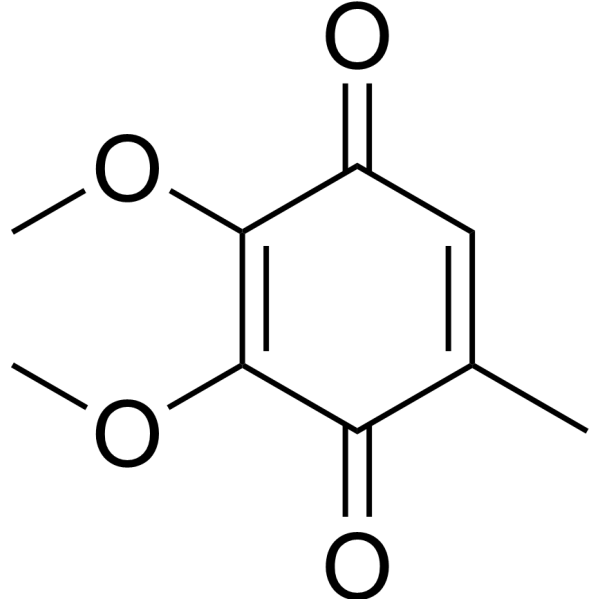
Coenzyme Q0  (Cat.#:AYB26736)

A
小A 扫码咨询

Cat.#:AYB26736

CAS:605-94-7

SizePrice
Free Sample (0.1 - 0.2 mg) Inquiry
1 g Inquiry
5 g Inquiry
500 mg ¥350.00 AddToCart
10 mM * 1 mL in DMSO ¥385.00 AddToCart
  • Biological activity

  • Information

Biological activity

Bioactivity Coenzyme Q0 (CoQ0) is a potent, oral active ubiquinone compound can be derived from Antrodia cinnamomea. Coenzyme Q0 induces apoptosis and autophagy, suppresses of HER-2/AKT/mTOR signaling to potentiate the apoptosis and autophagy mechanisms. Coenzyme Q0 regulates NFκB/AP-1 activation and enhances Nrf2 stabilization in attenuation of inflammation and redox imbalance. Coenzyme Q0 has anti-angiogenic activity through downregulation of MMP-9/NF-κB and upregulation of HO-1 signaling.
CAS 605-94-7
Mol.Wt. 182.18
In vitro

Coenzyme Q0 (0-40 µM; 24 h) and inhibits viability and growth of human ovarian carcinoma cells.
Coenzyme Q0 (CoQ0) (0-30 µM; 24 h; SKOV-3 cells) has anti-proliferative activity through induction of G2/M cell-cycle arrest and reduction of cell-cycle regulatory proteins.
Coenzyme Q0 (CoQ0) (0-30 µM; 0-30 min; SKOV-3 cells) increases intracellular ROS levels to promote SKOV-3 cell death.
Coenzyme Q0 (CoQ0) (0-30 µM; 24 h; SKOV-3 cells) induces autophagy by increase accumulation of LC3-II, GFP-LC3 puncta, AVOs formation and Beclin-1/Bcl-2 dysregulation.
Coenzyme Q0 (CoQ0) (0-30 µM; 24 h; SKOV-3 cells) induces apoptosis by mitochondrial (caspase-3, PARP and Bax/Bcl-2 dysregulation) and ER stress (caspase-12 and Hsp70) signals.
Coenzyme Q0 (CoQ0) (30 µM; 24 h; SKOV-3 cells) suppresses of HER-2/AKT/mTOR signaling to potentiate the apoptosis and autophagy mechanisms.
Coenzyme Q0 (CoQ0) (0-10 µM; 0.5-18 h; RAW264.7 cells) regulates NFκB/AP-1 activation and enhances Nrf2 stabilization.
Coenzyme Q0 (CoQ0) (5 µM; 0-12 h; EA.hy 926 cells) has anti-angiogenic activity in EA.hy 926 cells.

The accuracy of these methods have not been independently confirmed. They are for reference only.

Cell Viability Assay

Cell Line:SKOV-3, A2780 and A2870/CP70 cells
Concentration:0, 10, 20, 30 and 40 µM
Incubation Time:24 hours
Result:Decreased viability with the IC50 values of 26.6 µM, 27.3 µM and 28.4 µM for SKOV-3, A2780 and A2870/CP70 cells, respectively.

Cell Cycle Analysis

Cell Line:SKOV-3, A2780 and A2870/CP70 cells
Concentration:0, 10, 20 and 30 µM
Incubation Time:24 hours
Result:Arrested cell cycle at G2/M phase and reduced cell-cycle proteins in SKOV-3 cells.

Apoptosis Analysis

Cell Line:SKOV-3, A2780 and A2870/CP70 cells
Concentration:0, 5, 15 and 30 µM
Incubation Time:24 hours
Result:Promoted the conversion of LC3–1 to LC3-II and increased the LC3-II accumulation. Increased Bax/Bcl-2 ratio in a dose-dependent manner.

Apoptosis Analysis

Cell Line:SKOV-3 cells
Concentration:0, 10, 20 and 30 µM
Incubation Time:24 hours
Result:Had the percentage of early apoptotic cells are 25.1%, 34% and 36% for 10, 20 and 30 µM, respectively.

Western Blot Analysis

Cell Line:SKOV-3 cells
Concentration:0, 5, 15 and 30 µM
Incubation Time:24 hours
Result:Activated of caspase-3 and cleavaged of PARP. Increased the expressions of caspase-12, HSP-70 and Bax in a dose-dependent manner, decreased the expressions of Bcl-2.

Western Blot Analysis

Cell Line:SKOV-3 cells
Concentration:30 µM
Incubation Time:24 hours
Result:Decreased the phosphorylated HER-2 (Y1221) levels, p-AKT (Ser473) and p-mTOR (S2448) levels.

Western Blot Analysis

Cell Line:RAW264.7 cells
Concentration:0, 2.5, 5 and 10 µM
Incubation Time:0.5-18 hours
Result:Inhibited iNOS/COX-2 protein expressions with reductions of NO, PGE2, TNF-α and IL-1β secretions.

Western Blot Analysis

Cell Line:EA.hy 926 cells
Concentration:5 µM
Incubation Time:0, 1, 3, 6 and 12 hours
Result:Increased expressions of heme oxygenase-1 (HO-1) and γ-glutamylcysteine synthetase (γ-GCLC), inhibits protein expressions of matrix metalloproteinase-9 (MMP-9), reduces TNF-α-induced nuclear translocation and transcriptional activation of nuclear factor-κB (NF-κB).
Format Solid
Transportation Room temperature in continental US; may vary elsewhere.
Solubility
In Vitro: 

DMSO : 50 mg/mL (274.45 mM; Need ultrasonic)

配制储备液
浓度溶剂体积质量1 mg5 mg10 mg
1 mM5.4891 mL27.4454 mL54.8908 mL
5 mM1.0978 mL5.4891 mL10.9782 mL
10 mM0.5489 mL2.7445 mL5.4891 mL
*

请根据产品在不同溶剂中的溶解度选择合适的溶剂配制储备液;一旦配成溶液,请分装保存,避免反复冻融造成的产品失效
储备液的保存方式和期限:-80°C, 6 months; -20°C, 1 month。-80°C 储存时,请在 6 个月内使用,-20°C 储存时,请在 1 个月内使用。

In Vivo:

请根据您的实验动物和给药方式选择适当的溶解方案。以下溶解方案都请先按照 In Vitro 方式配制澄清的储备液,再依次添加助溶剂:

——为保证实验结果的可靠性,澄清的储备液可以根据储存条件,适当保存;体内实验的工作液,建议您现用现配,当天使用; 以下溶剂前显示的百
分比是指该溶剂在您配制终溶液中的体积占比;如在配制过程中出现沉淀、析出现象,可以通过加热和/或超声的方式助溶

  • 1.

    请依序添加每种溶剂: 10% DMSO    40% PEG300    5% Tween-80    45% saline

    Solubility: ≥ 1.67 mg/mL (9.17 mM); Clear solution

    此方案可获得 ≥ 1.67 mg/mL (9.17 mM,饱和度未知) 的澄清溶液。

    以 1 mL 工作液为例,取 100 μL 16.7 mg/mL 的澄清 DMSO 储备液加到 400 μL PEG300 中,混合均匀;向上述体系中加入50 μL Tween-80,混合均匀;然后继续加入 450 μL生理盐水定容至 1 mL。

    将 0.9 g 氯化钠,完全溶解于 100 mL ddH₂O 中,得到澄清透明的生理盐水溶液
  • 2.

    请依序添加每种溶剂: 10% DMSO    90% (20% SBE-β-CD in saline)

    Solubility: ≥ 1.67 mg/mL (9.17 mM); Clear solution

    此方案可获得 ≥ 1.67 mg/mL (9.17 mM,饱和度未知) 的澄清溶液。

    以 1 mL 工作液为例,取 100 μL 16.7 mg/mL 的澄清 DMSO 储备液加到 900 μL 20% 的 SBE-β-CD 生理盐水水溶液中,混合均匀。

    将 2 g 磺丁基醚 β-环糊精加入 5 mL 生理盐水中,再用生理盐水定容至 10 mL,完全溶解,澄清透明
*以上所有助溶剂都可在 MCE 网站选购。
Purity ≥99.0%

Information

Intro Coenzyme Q0 (CoQ0) 是一种口服有效的醌类化合物,可以从 Antrodia cinnamomea 中得到。Coenzyme Q0 诱导细胞凋亡 (apoptosis) 和自噬 (autophagy),抑制 HER-2/AKT/mTOR 信号通路来增强细胞凋亡和自噬机制。Coenzyme Q0 调节 NFκB/AP-1 的激活,并增强 Nrf2 的稳定,减轻炎症和氧化还原失衡。Coenzyme Q0 通过下调 MMP-9/NF-κB 和上调 HO-1 信号通路具有抗血管生成活性。
Synonym CoQ0
Rela_targets Bioactive Compound Library Plus Apoptosis Compound Library Cell Cycle/DNA Damage Compound Library Epigenetics Compound Library Immunology/Inflammation Compound Library JAK/STAT Compound Library Kinase Inhibitor Library Metabolism/Protease Compound Library NF-κB Signaling Compound Library PI3K/Akt/mTOR Compound Library Protein Tyrosine Kinase Compound Library Stem Cell Signaling Compound Library Anti-Cancer Compound Library Autophagy Compound Library Anti-Aging Compound Library Antioxidant Compound Library Differentiation Inducing Compound Library Reprogramming Compound Library Oxygen Sensing Compound Library Ferroptosis Compound Library Endoplasmic Reticulum Stress Compound Library Glycolysis Compound Library Pyroptosis Compound Library Cytoskeleton Compound Library Orally Active Compound Library Glutamine Metabolism Compound Library Neuroprotective Compound Library Anti-Hepatitis C Virus Compound Library Anti-Breast Cancer Compound Library Anti-Lung Cancer Compound Library Anti-Pancreatic Cancer Compound Library Anti-Blood Cancer Compound Library Anti-Cancer Metabolism Compound Library Anti-Obesity Compound Library Angiogenesis-Related Compound Library Mitochondria-Targeted Compound Library Transcription Factor-Targeted Library Glucose Metabolism Compound Library Anti-Liver Cancer Compound Library Anti-Colorectal Cancer Compound Library Antidepressant Compound Library Anti-Prostate Cancer Compound Library Anti-Pulmonary Fibrosis Compound Library Cancer Stem Cells Compound Library Pain-Related Compound Library Mitochondrial Protection Compound Library Membrane Protein-targeted Compound Library Membrane Receptor-targeted Compound Library
AYB26736