
CLOCK Rabbit mAb (Cat.#:AYM31358)
小A
Sales advisor

Scan with WeChat to add an advisor
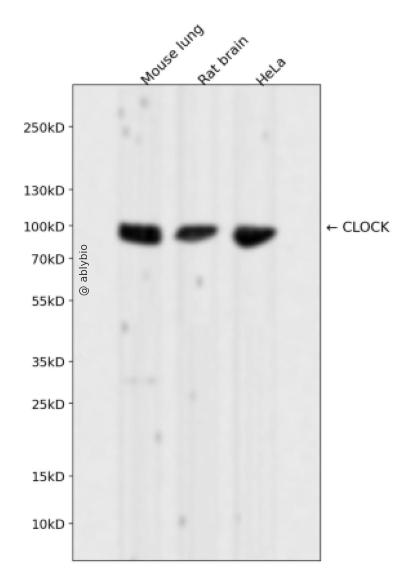
Western blot analysis of CLOCK expressed in Mouse lung,Rat brain,HeLa using CLOCK Rabbit mAb at 1:1000. Secondary antibody: HRP Goat Anti-Rabbit IgG (H+L) at 1:5000. Lysates/proteins: 30ug per lane. Blocking buffer: 5% non-fat dry milk in TBST. Detection: ECL Enhanced Kit. Exposure time: 120s.
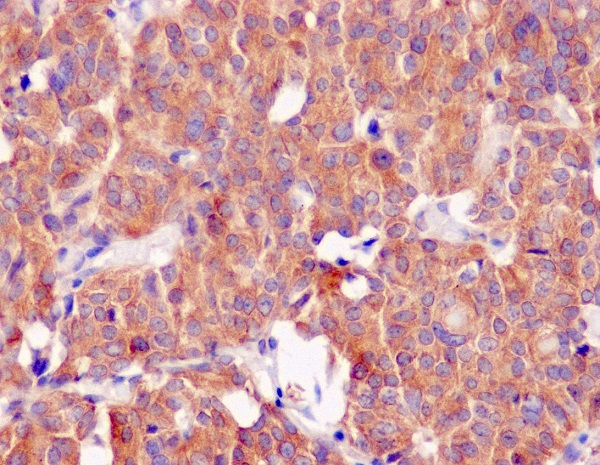
Immunohistochemical analysis of paraffin-embedded human thyroid carcinoma, using CLOCK Antibody.
Preview
Western blot - CLOCK Rabbit mAb
Western blot analysis of CLOCK expressed in Mouse lung,Rat brain,HeLa using CLOCK Rabbit mAb at 1:1000. Secondary antibody: HRP Goat Anti-Rabbit IgG (H+L) at 1:5000. Lysates/proteins: 30ug per lane. Blocking buffer: 5% non-fat dry milk in TBST. Detection: ECL Enhanced Kit. Exposure time: 120s.
Immunohistochemistry - CLOCK Rabbit mAb
Immunohistochemical analysis of paraffin-embedded human thyroid carcinoma, using CLOCK Antibody.
Cat.#:AYM31358
| Size | Price | |
|---|---|---|
| 50ul | ¥1150.00 | Add to cart |
| 100ul | ¥2100.00 | Add to cart |
Sales Terms | Request COA | Stock and shipping are confirmed by support
Information
Application guide
Immunogen
Target data
Resources
Protocols
FAQs
| Reactivity | Human,Mouse,Rat |
|---|---|
| Host | Rabbit |
| Clonality | Monoclonal |
| Isotype | IgG |
| Application | WBIHCIF/ICCFC |
| Dilution | WB: 1:500 - 1:2000 IHC: 1:50 - 1:200 IF/ICC: 1:50 - 1:200 FC: 1:20 - 1:50 |
| Predicted MW | 95kDa |
| Observed MW | 95kDa |
| Format | Liquid |
| Storage | Store at -20℃. Avoid freeze / thaw cycles. Buffer: PBS with 0.75% BSA,50% glycerol,pH7.3. |
| Conjugate | Unconjugated |
| Positive | HeLa,293T,NIH/3T3,SH-SY5Y,Mouse lung,Rat brain |
| Subcellular | Cytoplasm,Nucleus |
| Purification | Affinity purification |
Applications and conditions
These starting conditions come from the recommended dilution, validation images, and general assay practice. Titrate for your sample and detection system.
| Recommended dilution | 1:500 - 1:2000 |
|---|---|
| Suggested sample / positive control | HeLa,293T,NIH/3T3,SH-SY5Y,Mouse lung,Rat brain |
| Key conditions | Use a fresh lysate, incubate at the recommended dilution, and check the predicted and observed molecular weight |
| Expected result | Expected signal or band near 95kDa |
| Controls | Include a positive sample, a negative sample, and a secondary or isotype control |
| Recommended dilution | 1:50 - 1:200 |
|---|---|
| Suggested sample / positive control | HeLa,293T,NIH/3T3,SH-SY5Y,Mouse lung,Rat brain |
| Key conditions | For paraffin sections, optimize retrieval buffer pH, retrieval time, and primary incubation |
| Expected result | Expected localization: Cytoplasm,Nucleus |
| Controls | Include a positive sample, a negative sample, and a secondary or isotype control |
| Recommended dilution | 1:50 - 1:200 |
|---|---|
| Suggested sample / positive control | HeLa,293T,NIH/3T3,SH-SY5Y,Mouse lung,Rat brain |
| Key conditions | Optimize fixation, permeabilization, and blocking, and include a secondary-only control |
| Expected result | Expected fluorescence localization: Cytoplasm,Nucleus |
| Controls | Include a positive sample, a negative sample, and a secondary or isotype control |
| Recommended dilution | 1:20 - 1:50 |
|---|---|
| Suggested sample / positive control | HeLa,293T,NIH/3T3,SH-SY5Y,Mouse lung,Rat brain |
| Key conditions | For intracellular targets, optimize fixation and permeabilization, and include an isotype control |
| Expected result | Expect the positive population to shift relative to the negative or isotype control |
| Controls | Include a positive sample, a negative sample, and a secondary or isotype control |
Immunogen
| Immunogen | Recombinant fusion protein corresponding to Human CLOCK. |
|---|---|
| Sequence |
View sequenceWKPTFLSNEEFTQLMLEALDGFFLAIMTDGSIIYVSESVTSLLEHLPSDLVDQSIFNFIPEGEHSEVYKILSTHLLESDSLTPEYLKSKNQLEFCCHMLRG |
Target data
| Background | The protein encoded by this gene plays a central role in the regulation of circadian rhythms. The protein encodes a transcription factor of the basic helix-loop-helix (bHLH) family and contains DNA binding histone acetyltransferase activity. The encoded protein forms a heterodimer with ARNTL (BMAL1) that binds E-box enhancer elements upstream of Period (PER1, PER2, PER3) and Cryptochrome (CRY1, CRY2) genes and activates transcription of these genes. PER and CRY proteins heterodimerize and repress their own transcription by interacting in a feedback loop with CLOCK/ARNTL complexes. Polymorphisms in this gene may be associated with behavioral changes in certain populations and with obesity and metabolic syndrome. Alternative splicing results in multiple transcript variants. [provided by RefSeq, Jan 2014] |
|---|---|
| Gene ID | 9575 |
| Gene name | CLOCK |
| Swiss | O15516 |
| Synonym | CLOCK,CLOCK Rabbit mAb,Class E basic helix-loop-helix protein 8,BHLHE8,KIAA0334 |
| Expression | Hair follicles (at protein level). Expressed in all tissues examined including spleen, thymus, prostate, testis, ovary, small intestine, colon, leukocytes, heart, brain, placenta, lung, liver, skeletal muscle, kidney and pancreas. Highest levels in testis and skeletal muscle. Low levels in thymus, lung and liver. Expressed in all brain regions with highest levels in cerebellum. Highly expressed in the suprachiasmatic nucleus (SCN). |
| Functions | Transcriptional activator which forms a core component of the circadian clock. The circadian clock, an internal time-keeping system, regulates various physiological processes through the generation of approximately 24 hour circadian rhythms in gene expression, which are translated into rhythms in metabolism and behavior. It is derived from the Latin roots 'circa' (about) and 'diem' (day) and acts as an important regulator of a wide array of physiological functions including metabolism, sleep, body temperature, blood pressure, endocrine, immune, cardiovascular, and renal function. Consists of two major components: the central clock, residing in the suprachiasmatic nucleus (SCN) of the brain, and the peripheral clocks that are present in nearly every tissue and organ system. Both the central and peripheral clocks can be reset by environmental cues, also known as Zeitgebers (German for 'timegivers'). The predominant Zeitgeber for the central clock is light, which is sensed by retina and signals directly to the SCN. The central clock entrains the peripheral clocks through neuronal and hormonal signals, body temperature and feeding-related cues, aligning all clocks with the external light/dark cycle. Circadian rhythms allow an organism to achieve temporal homeostasis with its environment at the molecular level by regulating gene expression to create a peak of protein expression once every 24 hours to control when a particular physiological process is most active with respect to the solar day. Transcription and translation of core clock components (CLOCK, NPAS2, ARNTL/BMAL1, ARNTL2/BMAL2, PER1, PER2, PER3, CRY1 and CRY2) plays a critical role in rhythm generation, whereas delays imposed by post-translational modifications (PTMs) are important for determining the period (tau) of the rhythms (tau refers to the period of a rhythm and is the length, in time, of one complete cycle). A diurnal rhythm is synchronized with the day/night cycle, while the ultradian and infradian rhythms have a period shorter and longer than 24 hours, respectively. Disruptions in the circadian rhythms contribute to the pathology of cardiovascular diseases, cancer, metabolic syndromes and aging. A transcription/translation feedback loop (TTFL) forms the core of the molecular circadian clock mechanism. Transcription factors, CLOCK or NPAS2 and ARNTL/BMAL1 or ARNTL2/BMAL2, form the positive limb of the feedback loop, act in the form of a heterodimer and activate the transcription of core clock genes and clock-controlled genes (involved in key metabolic processes), harboring E-box elements (5'-CACGTG-3') within their promoters. The core clock genes: PER1/2/3 and CRY1/2 which are transcriptional repressors form the negative limb of the feedback loop and interact with the CLOCK|NPAS2-ARNTL/BMAL1|ARNTL2/BMAL2 heterodimer inhibiting its activity and thereby negatively regulating their own expression. This heterodimer also activates nuclear receptors NR1D1/2 and RORA/B/G, which form a second feedback loop and which activate and repress ARNTL/BMAL1 transcription, respectively. Regulates the circadian expression of ICAM1, VCAM1, CCL2, THPO and MPL and also acts as an enhancer of the transactivation potential of NF-kappaB. Plays an important role in the homeostatic regulation of sleep. The CLOCK-ARNTL/BMAL1 heterodimer regulates the circadian expression of SERPINE1/PAI1, VWF, B3, CCRN4L/NOC, NAMPT, DBP, MYOD1, PPARGC1A, PPARGC1B, SIRT1, GYS2, F7, NGFR, GNRHR, BHLHE40/DEC1, ATF4, MTA1, KLF10 and also genes implicated in glucose and lipid metabolism. Promotes rhythmic chromatin opening, regulating the DNA accessibility of other transcription factors. The CLOCK-ARNTL2/BMAL2 heterodimer activates the transcription of SERPINE1/PAI1 and BHLHE40/DEC1. The preferred binding motif for the CLOCK-ARNTL/BMAL1 heterodimer is 5'-CACGTGA-3', which contains a flanking Ala residue in addition to the canonical 6-nucleotide E-box sequence (PubMed:23229515). CLOCK specifically binds to the half-site 5'-CAC-3', while ARNTL binds to the half-site 5'-GTGA-3' (PubMed:23229515). The CLOCK-ARNTL/BMAL1 heterodimer also recognizes the non-canonical E-box motifs 5'-AACGTGA-3' and 5'-CATGTGA-3' (PubMed:23229515). CLOCK has an intrinsic acetyltransferase activity, which enables circadian chromatin remodeling by acetylating histones and nonhistone proteins, including its own partner ARNTL/BMAL1. Represses glucocorticoid receptor NR3C1/GR-induced transcriptional activity by reducing the association of NR3C1/GR to glucocorticoid response elements (GREs) via the acetylation of multiple lysine residues located in its hinge region (PubMed:21980503). The acetyltransferase activity of CLOCK is as important as its transcription activity in circadian control. Acetylates metabolic enzymes IMPDH2 and NDUFA9 in a circadian manner. Facilitated by BMAL1, rhythmically interacts and acetylates argininosuccinate synthase 1 (ASS1) leading to enzymatic inhibition of ASS1 as well as the circadian oscillation of arginine biosynthesis and subsequent ureagenesis (PubMed:28985504). |
| Research area |
Resources
Validation data
2 images
Validation images at the top of the page cover WB / IHC / IF/ICC / FC.
References
No papers are linked yet. Contact technical support for application examples.
Ask for examplesCustomer reviews
No reviews yet. After use, you can submit a review and experiment images.
Send feedbackSupport
Support can help confirm the application, sample, dilution, controls, and assay conditions.
Support centerSend the catalog number, application, sample type, and assay. Support can confirm dilution, controls, and COA or lot documents.