
RNF8 Rabbit mAb (货号:AYM30964)
A
小A
销售顾问

请使用微信扫一扫
添加顾问进行咨询
货号
AYM30964
靶点/基因
RNF8
宿主
Rabbit
克隆性
Monoclonal
反应种属
Human, Rat
应用
WB
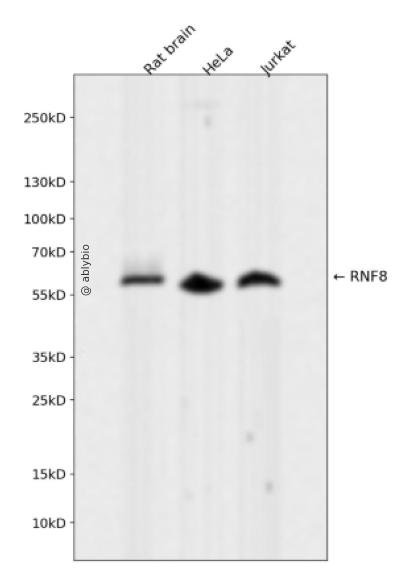
Western blot analysis of RNF8 expressed in Rat brain,HeLa,Jurkat using RNF8 Rabbit mAb at 1:1000. Secondary antibody: HRP Goat Anti-Rabbit IgG (H+L) at 1:5000. Lysates/proteins: 30ug per lane. Blocking buffer: 5% non-fat dry milk in TBST. Detection: ECL Enhanced Kit. Exposure time: 120s.
预览
Western blot - RNF8 Rabbit mAb
Western blot analysis of RNF8 expressed in Rat brain,HeLa,Jurkat using RNF8 Rabbit mAb at 1:1000. Secondary antibody: HRP Goat Anti-Rabbit IgG (H+L) at 1:5000. Lysates/proteins: 30ug per lane. Blocking buffer: 5% non-fat dry milk in TBST. Detection: ECL Enhanced Kit. Exposure time: 120s.
产品信息
应用指南
相关产品
抗原信息
靶点信息
资料与支持
实验步骤
常见问题
| 反应 | Human,Rat |
|---|---|
| 宿主 | Rabbit |
| 克隆性 | Monoclonal |
| 同种型 | IgG |
| 应用 | WB |
| 推荐浓度 | WB: 1:500 - 1:2000 |
| 理论分子量 | 10kDa/50kDa/55kDa |
| 实测分子量 | 60kDa |
| 形式 | Liquid |
| 保存条件 | Store at -20℃. Avoid freeze / thaw cycles. Buffer: PBS with 0.75% BSA,50% glycerol,pH7.3. |
| 偶联物 | Unconjugated |
| 阳性对照 | HeLa,Jurkat,Mouse brain,Mouse liver,Rat brain |
| 细胞定位 | Chromosome,Midbody,Nucleus,telomere |
| 纯化 | Affinity purification |
应用与推荐条件
快速判断怎么用
以下条件基于推荐浓度、验证图说明与通用实验要求整理,可作为预实验起点;不同样本和检测体系建议做梯度优化。
WB
WB 推荐条件
| 推荐稀释 | 1:500 - 1:2000 |
|---|---|
| 建议样本/阳性对照 | HeLa,Jurkat,Mouse brain,Mouse liver,Rat brain |
| 关键条件 | 建议使用新鲜裂解样本,按推荐稀释比例孵育一抗,并关注理论/实测分子量 |
| 预期结果 | 预期信号/条带约 60kDa |
| 对照设置 | 建议设置阳性样本、阴性样本和二抗/同型对照 |
相关产品
查找相关产品 >>
抗原信息
| 抗原信息 | Recombinant fusion protein corresponding to Human RNF8 . |
|---|---|
| 序列 |
查看序列MGEPGFFVTGDRAGGRSWCLRRVGMSAGWLLLEDGCEVTVGRGFGVTYQLVSKICPLMISRNHCVLKQNPEGQWTIMDNKSLNGVWLNRARLEPLRVYSIHQGDYIQLGVPLENKENAEYEYEVTEEDWETIYPCLSPKNDQMIEKNKELRTKRKFSLDELAGPGAEGPSNLKSKINKVSCESGQPVKSQGKGEVASTPSDNLDPKLTALEPSKTTGAPIYPGFPKVTEVHHEQKASNSSASQRSLQMFKVTMSRILRLK |
靶点信息
| 研究背景 | The protein encoded by this gene contains a RING finger motif and an FHA domain. This protein has been shown to interact with several class II ubiquitin-conjugating enzymes (E2), including UBE2E1/UBCH6, UBE2E2, and UBE2E3, and may act as an ubiquitin ligase (E3) in the ubiquitination of certain nuclear proteins. This protein is also known to play a role in the DNA damage response and depletion of this protein causes cell growth inhibition and cell cycle arrest. Alternative splicing results in multiple transcript variants. |
|---|---|
| 基因 ID | 9025 |
| 基因名 | RNF8 |
| Swiss | O76064 |
| 别名 | RNF8,RNF8 Rabbit mAb,RING finger protein 8,RING-type E3 ubiquitin transferase RNF8,KIAA0646 |
| 组织表达 | Ubiquitous. In fetal tissues, highest expression in brain, thymus and liver. In adult tissues, highest levels in brain and testis, lowest levels in peripheral blood cells. |
| 功能 | E3 ubiquitin-protein ligase that plays a key role in DNA damage signaling via 2 distinct roles: by mediating the 'Lys-63'-linked ubiquitination of histones H2A and H2AX and promoting the recruitment of DNA repair proteins at double-strand breaks (DSBs) sites, and by catalyzing 'Lys-48'-linked ubiquitination to remove target proteins from DNA damage sites. Following DNA DSBs, it is recruited to the sites of damage by ATM-phosphorylated MDC1 and catalyzes the 'Lys-63'-linked ubiquitination of histones H2A and H2AX, thereby promoting the formation of TP53BP1 and BRCA1 ionizing radiation-induced foci (IRIF). Also controls the recruitment of UIMC1-BRCC3 (RAP80-BRCC36) and PAXIP1/PTIP to DNA damage sites. Also recruited at DNA interstrand cross-links (ICLs) sites and catalyzes 'Lys-63'-linked ubiquitination of histones H2A and H2AX, leading to recruitment of FAAP20/C1orf86 and Fanconi anemia (FA) complex, followed by interstrand cross-link repair. H2A ubiquitination also mediates the ATM-dependent transcriptional silencing at regions flanking DSBs in cis, a mechanism to avoid collision between transcription and repair intermediates. Promotes the formation of 'Lys-63'-linked polyubiquitin chains via interactions with the specific ubiquitin-conjugating UBE2N/UBC13 and ubiquitinates non-histone substrates such as PCNA. Substrates that are polyubiquitinated at 'Lys-63' are usually not targeted for degradation. Also catalyzes the formation of 'Lys-48'-linked polyubiquitin chains via interaction with the ubiquitin-conjugating UBE2L6/UBCH8, leading to degradation of substrate proteins such as CHEK2, JMJD2A/KDM4A and KU80/XRCC5: it is still unclear how the preference toward 'Lys-48'- versus 'Lys-63'-linked ubiquitination is regulated but it could be due to RNF8 ability to interact with specific E2 specific ligases. For instance, interaction with phosphorylated HERC2 promotes the association between RNF8 and UBE2N/UBC13 and favors the specific formation of 'Lys-63'-linked ubiquitin chains. Promotes non-homologous end joining (NHEJ) by promoting the 'Lys-48'-linked ubiquitination and degradation the of KU80/XRCC5. Following DNA damage, mediates the ubiquitination and degradation of JMJD2A/KDM4A in collaboration with RNF168, leading to unmask H4K20me2 mark and promote the recruitment of TP53BP1 at DNA damage sites (PubMed:11322894, PubMed:14981089, PubMed:17724460, PubMed:18001824, PubMed:18001825, PubMed:18006705, PubMed:18077395, PubMed:18337245, PubMed:18948756, PubMed:19015238, PubMed:19124460, PubMed:19202061, PubMed:19203578, PubMed:19203579, PubMed:20550933, PubMed:21558560, PubMed:21857671, PubMed:21911360, PubMed:22266820, PubMed:22373579, PubMed:22531782, PubMed:22705371, PubMed:22865450, PubMed:22980979). Following DNA damage, mediates the ubiquitination and degradation of POLD4/p12, a subunit of DNA polymerase delta. In the absence of POLD4, DNA polymerase delta complex exhibits higher proofreading activity (PubMed:23233665). In addition to its function in damage signaling, also plays a role in higher-order chromatin structure by mediating extensive chromatin decondensation. Involved in the activation of ATM by promoting histone H2B ubiquitination, which indirectly triggers histone H4 'Lys-16' acetylation (H4K16ac), establishing a chromatin environment that promotes efficient activation of ATM kinase. Required in the testis, where it plays a role in the replacement of histones during spermatogenesis. At uncapped telomeres, promotes the joining of deprotected chromosome ends by inducing H2A ubiquitination and TP53BP1 recruitment, suggesting that it may enhance cancer development by aggravating telomere-induced genome instability in case of telomeric crisis. Promotes the assembly of RAD51 at DNA DSBs in the absence of BRCA1 and TP53BP1 Also involved in class switch recombination in immune system, via its role in regulation of DSBs repair. May be required for proper exit from mitosis after spindle checkpoint activation and may regulate cytokinesis. May play a role in the regulation of RXRA-mediated transcriptional activity. Not involved in RXRA ubiquitination by UBE2E2 (PubMed:11322894, PubMed:14981089, PubMed:17724460, PubMed:18001824, PubMed:18001825, PubMed:18006705, PubMed:18077395, PubMed:18337245, PubMed:18948756, PubMed:19015238, PubMed:19124460, PubMed:19202061, PubMed:19203578, PubMed:19203579, PubMed:20550933, PubMed:21558560, PubMed:21857671, PubMed:21911360, PubMed:22266820, PubMed:22373579, PubMed:22531782, PubMed:22705371, PubMed:22865450, PubMed:22980979). |
资料与技术支持
验证数据
1 张验证图
页面顶部轮播可查看应用验证图,覆盖 WB。
常见问题
当前页面标注应用包括 WB,建议结合页面验证图和推荐稀释比例进行预实验优化。
可通过页面询价/留言入口提交货号和批号,技术支持会协助提供对应批次资料。
页面推荐条件可作为起始浓度,不同样本、固定方式和检测体系可能需要梯度优化。