
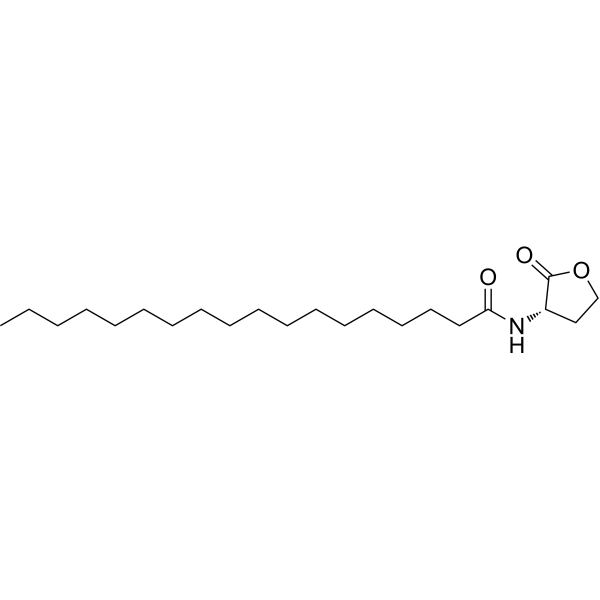
N-octadecanoyl-L-Homoserine lactone (货号:AYB27416)
A
小A
销售顾问

请使用微信扫一扫添加顾问进行咨询
生物活性
产品信息
生物活性
| 生物活性 | Quorum sensing is a regulatory system used by bacteria to control gene expression in response to increased cell density. This regulatory process manifests itself in a variety of phenotypes, including biofilm formation and virulence factor production. Coordinated gene expression is achieved through the production, release and detection of small diffusible signaling molecules called autoinducers. N-acylated homoserine lactones (AHLs) comprise a class of such autoinducers, each of which generally consists of a fatty acid coupled to a homoserine lactone (HSL). Modulation of bacterial quorum-sensing signaling systems to suppress pathogenesis represents a new approach to antimicrobial therapy for infectious diseases. AHLs differ in acyl length (C4-C18), C3 substitution (hydrogen, hydroxyl, or oxo group), and the presence or absence of one or more carbon-carbon double bonds in the fatty acid chain. These differences confer signaling specificity through the affinity of the LuxR family of transcriptional regulators. C18-HSL, one of four lipophilic long acyl side chain AHLs produced by the LuxI AHL synthase homolog SinI, is involved in quorum-sensing signaling in strains of Rhizobium meliloti (a nitrogen-fixing bacterial symbiont of the legume M. sativa) . C18-HSL and other hydrophobic AHLs tend to localize in the relatively lipophilic environment of bacterial cells and cannot diffuse freely across the cell membrane. Long-chain N-acyl homoserine lactones can be exported from cells by efflux pumps, or can be transported between communicating cells by extracellular outer membrane vesicles. |
|---|---|
| CAS | 479050-96-9 |
| 中文名称 | 十八酰基 -L-高丝氨酸内酯 |
| 分子量 | 367.57 |
| 运输条件 | Room temperature in continental US; may vary elsewhere. |
| 保存条件 | Please store the product under the recommended conditions in the Certificate of Analysis. |
产品信息
| Intro | 群体感应是细菌用来控制基因表达以响应增加的细胞密度的调节系统。这种调节过程表现为多种表型,包括生物膜形成和毒力因子产生。协调的基因表达是通过产生、释放和检测称为自诱导剂的小的可扩散信号分子来实现的。 N-酰化高丝氨酸内酯 (AHL) 包含一类这样的自诱导剂,其中每一种通常由与高丝氨酸内酯 (HSL) 偶联的脂肪酸组成。调节细菌群体感应信号系统以抑制发病机制代表了一种治疗传染病的抗微生物疗法的新方法。 AHL 在酰基长度 (C4-C18)、C3 取代(氢、羟基或氧代基团)以及脂肪酸链中存在或不存在一个或多个碳-碳双键方面存在差异。这些差异通过 LuxR 家族转录调节因子的亲和力赋予信号特异性。 C18-HSL 是由 LuxI AHL 合酶同系物 SinI 产生的四种亲脂性长酰基侧链 AHL 之一,参与苜蓿根瘤菌(豆科植物 M. sativa 的固氮细菌共生体)菌株中的群体感应信号传导。 C18-HSL 和其他疏水性 AHL 倾向于定位在相对亲脂性的细菌细胞环境中,不能自由扩散穿过细胞膜。长链 N-酰基高丝氨酸内酯可通过外排泵从细胞输出,或可通过细胞外外膜囊泡在通讯细胞之间转运。 |
|---|---|
| 别名 | N-[(3S)-Tetrahydro-2-oxo-3-furanyl]octadecanamide,十八酰基 -L-高丝氨酸内酯 |