首页
抗体
MAPKBP1 Rabbit pAb | Cat.# AYP17480
MAPKBP1 Rabbit pAb (货号:AYP17480)
宿主: Rabbit 克隆性: Polyclonal 反应: Human,Mouse,Rat WB
货号
AYP17480
靶点/基因
MAPKBP1
宿主
Rabbit
克隆性
Polyclonal
反应
Human, Mouse, Rat
应用
WB
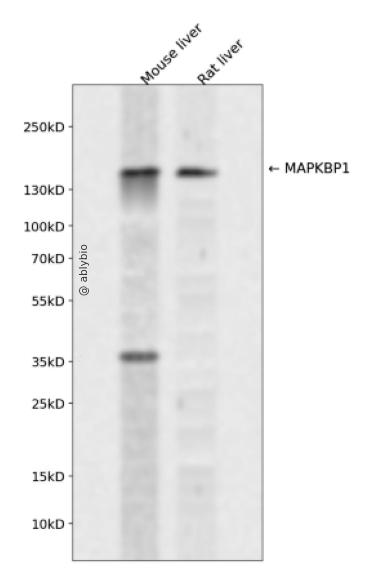
Western blot analysis of MAPKBP1 expressed in Mouse liver,Rat liver using MAPKBP1 Rabbit pAb at 1:1000. Secondary antibody: HRP Goat Anti-Rabbit IgG (H+L) at 1:5000. Lysates/proteins: 30ug per lane. Blocking buffer: 5% non-fat dry milk in TBST. Detection: ECL Enhanced Kit. Exposure time: 120s.
Previous
Next
Western blot - MAPKBP1 Rabbit pAb
Western blot analysis of MAPKBP1 expressed in Mouse liver,Rat liver using MAPKBP1 Rabbit pAb at 1:1000. Secondary antibody: HRP Goat Anti-Rabbit IgG (H+L) at 1:5000. Lysates/proteins: 30ug per lane. Blocking buffer: 5% non-fat dry milk in TBST. Detection: ECL Enhanced Kit. Exposure time: 120s.
Previous
Next
货号:AYP17480
规格 价格
50ul
¥1150.00
加购物车
100ul
¥2100.00
加购物车
大包装询价
给我们留言
销售条款
|
索取 COA
|
库存与发货以客服确认为准
产品信息 应用指南 抗原信息 靶点信息 资料与支持 实验步骤 常见问题
反应
Human,Mouse,Rat
宿主
Rabbit
克隆性
Polyclonal
同种型
IgG
应用
WB
推荐浓度
WB: 1:500 - 1:2000
理论分子量
23kDa/109kDa/134kDa/149kDa/163kDa
实测分子量
164kDa
形式
Liquid
保存条件
Store at -20℃. Avoid freeze / thaw cycles.
偶联物
Unconjugated
阳性对照
Mouse liver,Rat liver
细胞定位
cytoplasm,mitotic spindle pole,nucleolus,nucleoplasm
纯化
Affinity purification
应用与推荐条件
快速判断怎么用
以下条件基于推荐浓度、验证图说明与通用实验要求整理,可作为预实验起点;不同样本和检测体系建议做梯度优化。
1:500 - 1:2000
Mouse liver,Rat liver
建议使用新鲜裂解样本,按推荐稀释比例孵育一抗,并关注理论/实测分子量
预期信号/条带约 164kDa
建议设置阳性样本、阴性样本和二抗/同型对照
抗原信息
抗原信息
A synthetic peptide corresponding to a sequence within amino acids 1-100 of human MAPKBP1 (NP_001122080.1).
序列
查看序列
MAVEGSTITSRIKNLLRSPSIKLRRSKAGNRREDLSSKVTLEKVLGITVSGGRGLACDPRSGLVAYPAGCVVVLFNPRKHKQHHILNSSRKTITALAFSP
靶点信息
研究背景
This gene encodes a scaffold protein that regulates the JNK (c-Jun N-terminal kinase) and NOD2 (nucleotide-binding oligomerization domain-containing protein 2) signaling pathways. The encoded protein interacts with another related JNK pathway scaffold protein, WDR62, via a conserved dimerization domain, and enhances JNK signaling. This protein may play a role in bacterial immunity by binding to the NOD2 receptor and negatively regulating downstream antibacterial and pro-inflammatory signaling. Mutations in this gene that impair cellular localization of the encoded protein cause a form of nephronophthisis, an autosomal-recessive kidney disorder, in human patients.
基因 ID
23005
基因名
MAPKBP1
Swiss
O60336
别名
MAPKBP1,JNKBP-1,JNKBP1,NPHP20,MAPKBP1 Rabbit pAb,JNK-binding protein 1,KIAA0596
组织表达
Expressed in intestinal mucosa, where it is detected in epithelial cells, endothelial cells, smooth muscle cells and immune cells, such as lymphocytes (PubMed:22700971). Expressed in kidney (PubMed:28089251).
功能
Negative regulator of NOD2 function. It down-regulates NOD2-induced processes such as activation of NF-kappa-B signaling, IL8 secretion and antibacterial response (PubMed:22700971). Involved in JNK signaling pathway (By similarity).
资料与支持
验证数据
1 张验证图
页面顶部轮播可查看应用验证图,覆盖 WB。
文献引用
暂无公开文献关联,欢迎联系技术支持获取更多应用案例。
咨询案例
客户评价
暂无客户评价,使用后可提交评价与实验图片。
提交反馈
技术支持
可协助确认应用、样本、稀释比例、阳性/阴性对照和实验条件。
进入支持中心
需要确认应用条件?
请提供货号、实验应用、样本类型和检测体系,技术支持可协助确认稀释比例、阳性/阴性对照和 COA/批次资料。
常见问题
实验步骤
一、实验试剂及耗材
a. RIPA 裂解液
b. 蛋白酶抑制剂
c. BCA工作液
d. BSA Standard Solution(5mg/ml)
e. 1×PBS缓冲液
f. 5×loading buffer
a.30% Acr-Bis (29:1)
b.1 M Tris-HCl (pH6.8)
C.1.5M Tris-HCl (pH8.8)
d.10%SDS
e.10%Ammonium persulfate (APS)
f.TEMED
a. 1X Tris-Glycine SDS Running Buffer
b. 1X Western Transfer Buffer
c. Filter Paper (7.5×10cm)
d. Nitrocellulose membrane
a. 1XTBST Buffer
b. 1X Western Blocking Buffer
c. Skimmed milk powder
d. Bovine Serum Albumin (BSA)
e. Western Antibody Dilution Buffer
f. HRP 偶联二抗(AS014/AS003)
g. SignalFire™ ECL Reagent
二、实验步骤
(1)细胞收集
a. 贴壁培养细胞收集
b. 悬浮培养细胞收集
c. 组织样本收集
(2)总蛋白提取
a. 细胞/组织裂解7 个细胞(1个T75培养瓶细胞量)的比例加入相应体积的裂解液(细胞量足够时都加入3mL,不足时根据细胞量计算),裂解20min,每隔5min将离心管置于涡旋振荡仪上震荡10s。组织碎片按照0.5mL 裂解液/100mg组织向匀浆器中加入蛋白裂解液,每3min研磨一次,重复5次,使组织尽量碾碎。(裂解液中根据需要选择添加或不添加蛋白酶抑制剂)。
b. 离心
c. 蛋白变性
(3)蛋白浓度测定(BCA法)
a. BCA工作液的配置
b. 标准品测定
(1)制胶器安装
(2)分离胶制备
根据不同蛋白大小,选择不同浓度的分离胶(见附件表)。将制备好的胶溶液注入预先安装好的制胶器中,加入异丙醇封胶。室温水平放置30min左右。注意防止胶溶液产生气泡并注入制胶器中;注胶前再加入TEMED,防止注胶前凝固;注入异丙醇时需沿玻板一边缓慢拖动加入。
(3)浓缩胶制备
分离胶凝固后,沿玻板一边倒出异丙醇,并用滤纸吸干。再根据需要的体积制备浓缩胶(见附表)。将制备好的胶溶液注入制胶器中,并把准备好的样品梳沿玻板一端缓慢插入胶溶液中,室温水平放置20-30min。注意样品梳与胶溶液之间避免气泡产生。
(4)上样
待浓缩胶凝固好后,双手垂直拔出样品梳,并用Tris-Glycine SDS Running Buffer注入到内外槽中,形成闭合回路。用移液器吸取样品垂直梳孔上样,蛋白含量25ug/孔。注意内槽Tris-Glycine SDS Running Buffer需注满,外槽Tris-Glycine SDS Running Buffer没过底部3~5cm即可。
(5)电泳
上样完以后,连通电泳仪电源,注意正负极需连接正确,设定适宜的电泳参数,浓缩胶电泳参数为恒压80V,待样本进入分离胶是,可将电泳调至120V。当溴酚蓝电泳到凝胶底部时,停止电泳,关闭电泳仪电源,或根据目的蛋白分子量大小参照Marker电泳情况延长电泳时间。
(1)准备工作
a. Western Transfer Buffer至少提前2h (即开始电泳后)放入-20℃冰箱预冷,但注意避免结冰。
b. 根据胶体大小,将Filter Paper及Nitrocellulose membrane剪裁至合适尺寸。
c. 目的蛋白>20KD选择0.45μm NC膜/PVDF膜;目的蛋白<20KD选择0.2μmNC膜或PVDF膜,选择完毕后将NC膜放在Western Transfer Buffer中浸泡备用,注意如使用的是PVDF膜需先放入甲醇中浸泡5-10min,再放入Western Transfer Buffer中浸泡备用。
(2)转膜
取出玻板中的凝胶,在夹板上依次放一块多孔垫、三张滤纸、凝胶、膜、三张滤纸、一块多孔垫(“三明治”结构),将转好的膜放在转膜槽,按一定的条件进行转膜。(见附表)
将膜从“三明治”结构中取出,放入合适的抗体孵育槽中,加入Western Blocking Buffer室温孵育1h,一张6.3×8.3cm大小的膜加入6~7ml即可。
a. 将一抗用1X Western Blocking Buffer/1XTBST Buffer按照合适比例进行稀释。
b. 封闭结束后,将稀释好的一抗工作液倒入孵育槽中,室温2h或4℃过夜。
一抗孵育结束后,加入TBST Buffer洗涤4次,5min/次。
a. 一抗洗涤结束前10min,将二抗用1XTBST Buffer按照合适比例进行稀释。
b. 洗涤结束后,将稀释好的二抗工作液加入孵育槽中,室温1h。
二抗孵育结束后,加入TBST Buffer洗涤4次,5min/次。
a. 根据膜的大小,按每 10cm2 膜使用 1-2ml 工作液,按比例吸取等体积的 SolutionⅠ和 SolutionⅡ混匀,配制成发光检测工作液。
b. 用平头镊子将膜取出,膜的下缘轻轻接触吸水纸,去除膜上多余的液体。用移液器将工作液加到转印膜上,使其均匀覆盖,室温孵育 1-2min,此步骤可在洁净保鲜膜上或塑料盒中完成。
c. 压片检测:将膜固定于片夹内。暗室内压片 1 分钟,立即显影定影,根据结果再调整压片时间。或直接分别压片 30s、60s、90s、180s,然后一起显影定影观察结果。
d. 荧光成像仪检测:将膜放置到荧光成像仪内,参考仪器说明书进行检测。
一、实验仪器及试剂
微波炉、4℃冰箱、恒温恒湿箱、烘箱、光学显微镜、移液器、孵育湿盒、抗原修复盒。
(1) 缓冲液:0.01M PBS pH7.2±0.2; 0.01M pH7.2 PBST;
试剂名称
1*PBS/L
试剂名称
1*PBST/L
NaH2 PO4
0.23g
1*PBS溶液
1L
Na2 HPO4
1.15g
Tween 20 溶液
0.001L
NaCl
8.5g
用稀HCl溶液和NaOH溶液调pH值
(2) 修复液(可选):6 H8 O7 •H2 O 0.4g;NaC6 H5 O7 •2H2 O 3g;pH6.0;2 PO4 0.07g;NaCl 7.89g;Na2 HPO4 0.45g;KCl 0.10g;pH7.2-7.4;4 H11 NO3 6.05g;C10 H14 N2 Na2 O8 •2H2 O 0.29g;用稀HCl调至pH8.0;4 H11 NO3 1.21g;C10 H14 N2 Na2 O8 •2H2 O 0.37g;pH9.0。
(3) 封闭液:5%空白山羊血清;
(4) 3%过氧化氢(需新鲜配制,30% H2 O2 与dH2 O体积比1:9);
(5) 抗体稀释液:1X PBS + 5% 正常血清 + 0.3% Triton™ X-100;
(6) EnVision Systems检测体系, HRP显色系统: HRP RABBIT/MOUSE及配套DAB显色液;
(7) 脱蜡液、无水乙醇(分析纯)、去离子水(dH2 O)、Mayer’s苏木素、中性树胶封片剂。
二、实验步骤
(1)烤片:将石蜡切片按同一朝向放置在切片架上,将其放入55℃的恒温箱中烤片30分钟;同时将脱蜡液1缸一起放入55℃的恒温箱中;
(2)脱蜡至水:将石蜡切片连同切片架一起放入脱蜡液1缸中,再一起从恒温箱中取出置于常温,5分钟后,将切片取出浸入到常温脱蜡液2缸中,并按照脱蜡液2、脱蜡液3、无水乙醇1、无水乙醇2、无水乙醇3的顺序依次将石蜡切片放入缸中,每缸5分钟;用流水清洗切片5分钟。
注意:流水清洗时水流不能直接对着切片;操作过程中需一直保持切片处于湿润状态。
将切片完全浸入到3%双氧水溶液中,室温,孵育10分钟;完成后流水清洗5分钟。
注意:内源性酶含量高的组织,可以延长灭活时间至15-20分钟;双氧水需新鲜配制,可提前5-10分钟配制3%的双氧水。
(1)方法一,微波热修复:将切片浸入盛有修复液的修复盒中,将抗原修复盒盖斜盖在修复盒上;整体放入微波炉中,高火加热3分钟后停火,微波炉内静置5分钟;再高火加热3分钟后停火,微波炉内静置5分钟;随后中低火加热1分钟后停火,微波炉内静置5分钟,然后将切片连同抗原修复盒拿出缓慢冷却至室温。待修复液温度降至室温后,用缓冲液PBS洗涤3次,每次1min。
(2)方法二,高压热修复:在高压锅中,加入抗原修复液,高火预热;待修复液沸腾后将切片置于其中,并完全浸泡组织,盖好锅盖,扣上压力阀,高火继续加热;待限压阀开始转动喷气后调至中火,同时开始计时2分钟;计时结束后离开热源,自然降压后将高压锅移入冷水中缓慢冷却。待修复液温度降至室温后,用缓冲液PBS洗涤3次,每次1min。
注意:修复液需完全浸没切片上组织;修复过程中严禁打开仪器或中断运行程序;修复完成后避免快速冷却;修复液可根据实验需求自行选用修复液。
(1)封闭:待修复液温度降至室温后,从修复盒中取出切片;用缓冲液PBS清洗切片2次,每次3分钟;去除切片上的缓冲液;在组织切片上滴加5%空白山羊血清封闭液;将切片水平放置在底部呈有水的孵育湿盒中,于37℃恒温孵育30分钟;
(2)一抗孵育:去除封闭液,在组织切片上滴加用缓冲液PBS稀释的一抗,水平放置于孵育湿盒中,于4℃孵育过夜;
(3)复温:将孵育湿盒取出室温复温15-30分钟,去除抗体工作液,用缓冲液PBST洗涤1次,5分钟;用缓冲液PBS洗涤3次,每次5分钟;
(4)二抗孵育:在组织切片上滴加二抗工作液后水平放置于孵育湿盒中,于37℃恒温孵育1h;
(5)去除切片上的溶液,用缓冲液PBST洗涤1次,5分钟;用缓冲液PBS洗涤3次,每次5分钟;
(6)显色:显色前5分钟,配置DAB显色工作液,C液:B液体积比1:100,充分混匀;在组织切片上滴加显色工作液,显微镜下密切观察颜色变化情况,通常10-60秒即可得到合适的染色强度;将切片浸入大量dH2O中即可终止显色;
(7)复染、返蓝:将切片浸入Mayer’s苏木素中复染切片,用流水清洗10分钟。
注意:染色过程中需一直保持切片处于湿润状态;染色过程中所有试剂使用过程中均需保证完全覆盖切片上组织。
(1)脱水:将清洗后的切片于无水乙醇中浸泡1次,10秒;高温(55℃-60℃)下完全干燥;
(2)封片:在切片中心滴加适量中性树胶,并加盖盖玻片。
一、实验仪器及试剂
4℃冰箱、恒温恒湿箱、通风橱、移液器、避光孵育湿盒。
(1) 缓冲液:0.01M pH7.2±0.2 TBS ;0.01M pH7.2±0.2 TBST
试剂名称
1*TBS/L
试剂名称
1*TBST/L
Tris
1.21g
1*TBS
1L
NaCl
8.8g
Tween 20 溶液
0.001L
用稀HCl溶液和NaOH溶液调pH值
用稀HCl溶液和NaOH溶液调pH值
(2) 固定液:4%中性甲醛固定液(TBS缓冲液配制)
(3) 抗体稀释液:1X TBS / 5% 正常血清 / 0.3% Triton™ X-100
(4) 通透剂:0.3% Triton X-100(TBS缓冲液配制)
(5) 二抗(可选):
(6) 染核试剂:1mg/mL DAPI(用时使用0.01M pH7.2 TBS缓冲液配制)
(7) 去离子水(dH2 O)、抗荧光衰减封片剂。
二、实验步骤
(1) 弃去培养基,在细胞上缓慢加入常温TBS,清洗2次,每次5秒;
(2) 细胞固定:在细胞上覆盖 4%中性甲醛固定液(TBS缓冲液配制),置于4℃,固定15min;固定液需足量;
(3) 固定液的清洗:去除固定液,使用4℃预冷的TBS缓冲液,漂洗3次,每次5分钟;
注意:需避免实验操作时温差过大或温度骤变;固定液需保证足量,可过量使用;甲醛有毒性,加固定液和固定后的清洗需在通风橱内操作。
(1)封闭:用5%空白山羊血清将样本完全覆盖,切片需放置于湿盒内,细胞孔板可直接将孔板密封好,置于37℃恒温恒湿培养箱孵育30min;
(2)一抗孵育:去除封闭液,直接在样本上滴加TBS缓冲液配制的一抗工作液,样本需完全覆盖,切片需放置于湿盒内,细胞孔板可直接将孔板密封好,置于4℃孵育过夜;
(3)复温:将样本置于常温,复温15min,去除抗体工作液,用缓冲液TBST洗涤1次,5分钟;用缓冲液TBS洗涤3次,每次5分钟;
(4)二抗孵育:在样本上滴加与一抗种属对应的荧光二抗工作液,样本需完全覆盖,避光,37℃,孵育1小时;去除二抗工作液,用缓冲液TBST洗涤1次,5分钟;用缓冲液TBS洗涤3次,每次5分钟;
(5)染核:在样本上滴加DAPI工作液,使用0.01M pH7.2±0.2 TBS缓冲液配制,DAPI溶液:TBS缓冲液体积比1:500,避光,室温,孵育10分钟;去除DAPI工作液,用缓冲液TBST洗涤1次,5分钟;用缓冲液TBS洗涤3次,每次5分钟;
(6)细胞孔板可直接加入抗荧光衰减封片剂后,于荧光显微镜下观察并采集图像;细胞涂片滴加抗荧光衰减封片剂,然后加盖盖玻片封片,再于荧光显微镜下观察并采集图像;细胞爬片可取出,盖在滴加抗荧光衰减封片剂的载玻片上后,于荧光显微镜下观察并采集图像。
注意:实验中,所有试剂滴加应准确、快速、足量,不能出现干片的情况;染色步骤从二抗孵育开始,后续所有步骤都需注意避光操作;染色完成后需及时观察并采集图像,避免干燥和荧光物质淬灭。
一、实验仪器及试剂
微波炉、4℃冰箱、恒温恒湿箱、烘箱、移液器、避光孵育湿盒、抗原修复盒。
(1) 缓冲液:0.01M pH7.2±0.2 TBS ;0.01M pH7.2±0.2 TBST
试剂名称
1*TBS/L
试剂名称
1*TBST/L
Tris
1.21g
1*TBS
1L
NaCl
8.8g
Tween 20 溶液
0.001L
用稀HCl溶液和NaOH溶液调pH值
用稀HCl溶液和NaOH溶液调pH值
(2) 修复液(可选):6 H8 O7 •H2 O 0.4g;NaC6 H5 O7 •2H2 O 3g;pH6.0;2 PO4 0.07g;NaCl 7.89g;Na2 HPO4 0.45g;KCl 0.10g;pH7.2-7.4;4 H11 NO3 6.05g;C10 H14 N2 Na2 O8 •2H2 O 0.29g;用稀HCl调至pH8.0;4 H11 NO3 1.21g;C10 H14 N2 Na2 O8 •2H2 O 0.37g;pH9.0。
(3) 封闭液:5%空白山羊血清
(4) 抗体稀释液:1X TBS / 5% 正常血清 / 0.3% Triton™ X-100
(5) 二抗:
(6) 染核试剂:1mg/mL DAPI(用时使用0.01M pH7.2±0.2 TBS配制)
(7) 去离子水(dH2 O)、抗荧光衰减封片剂。
二、实验步骤
(1) 烤片:将石蜡切片按同一朝向放置在切片架上,将其放入55℃的恒温箱中烤片30分钟;同时将脱蜡液1缸一起放入55℃的恒温箱中;
(2) 脱蜡至水:将石蜡切片连同切片架一起放入脱蜡液1缸中,再一起从恒温箱中取出置于常温,5分钟后,将切片取出浸入到常温脱蜡液2缸中,并按照脱蜡液2、脱蜡液3、无水乙醇1、无水乙醇2、无水乙醇3的顺序依次将石蜡切片放入缸中,每缸5分钟;用流水清洗切片5分钟。
注意:流水清洗时水流不能直接对着切片;操作过程中需一直保持切片处于湿润状态。
(1)方法一,微波热修复:将切片浸入盛有修复液的修复盒中,将抗原修复盒盖斜盖在修复盒上;整体放入微波炉中,高火加热3分钟后停火,微波炉内静置5分钟;再高火加热3分钟后停火,微波炉内静置5分钟;随后中低火加热1分钟后停火,微波炉内静置5分钟,然后将切片连同抗原修复盒拿出缓慢冷却至室温。
注意:修复液需完全浸没切片上组织;修复过程中严禁打开微波炉门;修复完成后不可快速冷却;修复液可根据实验需求自行换用其他类型修复液。
(2)方法二,高压热修复:在高压锅中,加入抗原修复液,高火预热;待修复液沸腾后将切片置于其中,并完全浸泡组织,盖好锅盖,扣上压力阀,高火继续加热;待限压阀开始转动喷气后调至中火,同时开始计时2分钟;计时结束后离开热源,自然降压后将高压锅移入冷水中缓慢冷却。待修复液温度降至室温后,用缓冲液洗涤3次,每次1min。
注意:修复液需完全浸没切片上组织;修复过程中严禁打开仪器或中断运行程序;修复液可根据实验需求自行换用其他类型修复液。
(1)封闭:用5%空白山羊血清将样本完全覆盖,切片需放置于湿盒内,置于37℃恒温恒湿培养箱孵育30min;
(2)一抗孵育:去除封闭液,直接在样本上滴加TBS缓冲液配制的一抗工作液,样本需完全覆盖,切片需放置于湿盒内,置于4℃孵育过夜;
(3)复温:将样本置于常温,复温15min,去除抗体工作液,用缓冲液TBST洗涤1次,5分钟;用缓冲液TBS洗涤3次,每次5分钟;
(4)二抗孵育:在样本上滴加与一抗种属对应的荧光二抗工作液,样本需完全覆盖,避光,37℃,孵育1小时;去除二抗工作液,用缓冲液TBST洗涤1次,5分钟;用缓冲液TBS洗涤3次,每次5分钟;
(5)染核:在样本上滴加DAPI工作液,使用0.01M pH7.2 TBS缓冲液配制,DAPI溶液:0.01M pH7.2 TBS缓冲液体积比1:500,避光,室温,孵育10分钟;去除DAPI工作液,用缓冲液TBST洗涤1次,5分钟;用缓冲液TBS洗涤3次,每次5分钟;
(6)滴加抗荧光衰减封片剂,然后加盖盖玻片封片,再于荧光显微镜下观察并采集图像。
注意:实验中,所有试剂滴加应准确、快速、足量,不能出现干片的情况;染色步骤从二抗孵育开始,后续所有步骤都需注意避光操作;染色完成后需及时观察并采集图像,避免干燥和荧光物质淬灭。
一、实验试剂
(1)rProtein A/G Plus MagPoly Beads
(2)裂解液&洗杂液:Cell lysis buffer for IP (without inhibitors)
(3)蛋白酶抑制剂
(4)封闭液:含 3% BSA 的 1X PBS
(5)1×PBS 缓冲液
(6)5×loding buffer(使用时用去离子水稀释至工作浓度即可)
(7)Control IgG (AC005/ AC011/AC034)
二、实验步骤
(1)贴壁培养细胞
a. 取裂解液室温溶解混匀,根据需要选择添加或不添加蛋白酶抑制剂。
b. 去除贴壁细胞的培养液,用PBS、NS或无血清培养基清洗1次,低速离心,弃上清,留取沉淀。
c. 按照6孔板每孔加入100~200μl裂解液的比例,加入裂解液。移液器轻轻吹打,使裂解液和细胞充分接触。通常裂解液作用于细胞1~5s内,细胞会被裂解。
d. 1000~12000g,离心3~5min(如果用冷冻离心机4℃效果更佳),取上清。
(2)悬浮培养细胞
a. 取裂解液室温溶解混匀,根据需要选择添加或不添加蛋白酶抑制剂。
b. 速离心悬浮细胞,弃上清,收集沉淀。
c. 手指轻弹细胞,使其松散。按照6孔板每孔加入100~200μl裂解液的比例,加入NP-40裂解液。通常6孔板每孔加入100~200μl裂解液已经足够,但如果细胞密度非常高可以适当加大裂解液的用量150~200μl,再用手指轻弹以充分裂解细胞。充分裂解后应无明显沉淀。
d. 1000~12000g,离心3~5min(如果用冷冻离心机4℃效果更佳),取上清。
(3)组织样本
a. 取裂解液室温溶解混匀,根据需要选择添加或不添加蛋白酶抑制剂。
b. 把组织剪切成细小的碎片,越小越好。
c. 取液氮或超低温冰箱中冷冻30min以上的组织,迅速用液氮研磨,研磨过程尽量控制在1~2min之内,以减少蛋白的降解。
d. 按照每20mg组织加入100~200μl裂解液的比例,加入含有PMSF的裂解液。冰上或4℃裂解30-60min。(步骤3、4也可采用以下过程:按照每20mg组织加入100~200μl裂解液的比例加入NP-40裂解液。用玻璃匀浆器或组织研磨器匀浆,直至充分裂解,过程尽量控制在1~2min之内,以减少蛋白的降解。)
e. 按照每20mg组织加入100~200μl裂解液的比例,加入裂解液。
f. 1000~12000g,4℃离心10~15min(如无低温离心机,室温下离心也可),取上清。
(1)将rProtein A/G Plus MaqPoly Beads颠倒或漩涡混匀,翻转瓶身发现底部无黑色沉淀即可。
(2)取30μl rProtein A/G Plus MaqPoly Beads至新的EP管中,放在磁分离器上,待溶液澄清后,用移液器吸弃保护液。
(3)将EP管从磁分离器上取下来,加入1ml Cell lysis buffer for IP (without inhibitors),混匀,放置在磁分离器上,收集磁珠,用移液器吸弃洗杂液,重复2次。
(4)将EP管从磁分离器上取下来,加入1mL的3% BSA,置于翻转混合仪4℃封闭1h.
(5)重复步骤3),备用。
(1)将含有抗原的样品(通常300μl-1000μl,总蛋白量200μg)中加入目标抗体(通常3μg),置于翻转混合仪4℃下反应2h或过夜。
(2)将上述完成抗体-抗原结合的复合物与备用好的磁珠进行混合,置于4℃下反应2h或过夜。
(3)将上述磁珠-抗体-抗原复合物放在磁分离器上进行分离,收集上清液,以备后续检测。
(4)向离心管中加入1ml洗杂液,用移液器轻轻吹打使磁珠-抗体-抗原复合物均匀分散,然后进行磁性分离,弃上清液;从磁分离器上取下离心管,重复洗涤两次。
(1)变性洗脱(此方法洗脱的样品适用于SDS-PAGE检测。)
a. 从磁分离器上取下离心管,向其中加入30μl 2X SDS-PAGE Loading Buffer混合均匀,95℃加热15min。
b. 置于磁性分离器上进行磁性分离,收集上清液进行SDS-PAGE检测。
(2)非变性洗脱
a. 向磁珠-抗体-抗原复合物中加入50μl洗脱液,混合均匀,室温孵育5min。
b. 置于磁性分离器上进行磁性分离,收集洗脱液至新的EP管中。
c. 重复步骤1)和2),收集洗脱液,与2)中洗脱液混合,加入中和液中和至pH7.0-8.0。用于后期功能分析。
一、实验试剂
(1)PBS缓冲液
(2)TE 缓冲液
(3)甲醛:40%
(4)甘氨酸:20%
(5)Lysis Buffer
(6)Dilution buffer
(7)Wash buffer I
(8)Wash buffer II
(9)Wash buffer III
(10)Elution buffer
(11)rProtein A/G Plus MagPoly Beads
二、实验步骤
(1)取1x10⁷ 细胞,加入1ml PBS和25ul甲醛(40%)混匀后,于冰上放置10min(混匀2-3次)。
(2)加入50ul甘氨酸(20%),混匀后静置5min。
(3)3000rpm离心5min,用1ml PBS清洗2遍。
(4)加入200ul Lysis Buffer(含10ul蛋白酶抑制剂),置于旋转摇床4℃裂解30min。
(5)加入800ul Dilution buffer,混匀后超声15-20min。
(6)12000rpm离心10min取上清,吸取少量裂解液DNA回收检测。
(7)琼脂糖电泳检测DNA打断程度,DNA长度应在150-900 bp之间。
(8)使用Qubit™荧光定量仪检测染色质浓度。
注意:整个过程在低温下进行,超声条件根据检测结果进行调整。
(1)取60ul 磁珠加入1ml BSA(1mg/ml,TE缓冲液配制),于旋转摇床4℃旋转5min,至于磁力架弃去液体,加入1ml BSA重复此操作1次。
(2)加入1ml TE溶液清洗磁珠两次,于4℃放置备用。
(3)取180ul染色质裂解液,加入320ul Dilution buffer(一份IP样品), 分别加入5ul抗体,1ul Normal Rabbit IgG,5ul Histone H3于4℃过夜,然后加入60ul处理好的磁珠,4℃孵育2h。
(4)依次使用Wash buffer I/II/III 洗涤磁珠,完成后使用TE溶液洗涤两次。
(5)弃去上清后加入200ul Elution buffer,置于旋转摇床室温旋转10min。
(6)吸取上清加入10ul蛋白酶K,65℃水浴至少4h。
(7)使用DNA回收试剂盒回收DNA。
注意:每份IP样本应含DNA的量为7-10ug DNA(转录因子15-20ug),抗体加入量为3-5ug,可根据实验进行优化。
(1)反应体系 (20ul)
DNA模板:
5 μl
引物:
5 μl
Green Master Mix:
10 μl
(2)反应体系 (20ul)
Stage 1
预变性
Reps: 1
95 ℃
5 min
Stage 2
循环反应 b
Reps: 40
95 ℃
10 sec
60 ℃
30 sec
Stage 3
融解曲线
Reps: 1
95 ℃
15 sec
60 ℃
60 sec
95 ℃
15 sec
假设 Input 起始浓度为 a,Ct1 个循环数扩增后达到阈值;IgG 起始浓度为 b,Ct2 个循环数扩增后达到阈值;目的蛋白起始浓度为 c,Ct3 个循环数扩增后达到阈值。则可以得到如下公式:
a×2Ct1 = b×2Ct2 = c×2Ct3
b/a = 2Ct1 /2Ct2 = 2(Ct1-Ct2)
b:a=2(Ct1-Ct2)
c/a = 2Ct1 /2Ct3 = 2(Ct1-Ct3)
c:a=2(Ct1-Ct3)
检测结果=2(Ct1-Ct3) /2(Ct1-Ct2)
1. 细胞计数:将培养好的细胞收集于50 mL离心管中并计数;500 g离心4 min,去上清;
2. 制备单细胞悬液:将收集的细胞用 1mL 0.5% BSA/PBS溶液重悬,400 g离心3 min,去上清,重复2次;用 0.5% BSA/PBS溶液重悬细胞,分配到96孔板中,每孔50 μL细胞悬液;
3. 一抗孵育:每孔加入一抗稀释液50 μL。振荡,室温反应20 min;
4. 洗涤:400 g离心5 min,去上清;
5. 二抗孵育:如非荧光染料直标抗体加入100 μL 荧光二抗 ,重悬避光振荡,室温反应20 min;直标荧光抗体直接跳转到步骤8;
6. 以 400 g 的速度离心 5 分钟,去上清;
7. 洗涤:加入200 μL 0.5% BSA/PBS重悬,400 g离心5 min,去上清,重复两遍;
8. 用200 μL 0.5% BSA/PBS重悬细胞,上机分析。
1. 将培养好的细胞收集于50 mL离心管中并计数;500 g离心4 min,去上清;
2. 将收集的细胞用1mL 0.5% BSA/PBS溶液重悬,400 g离心3 min,弃上清,用 0.5% BSA/PBS溶液重悬细胞,按设计方案对应96孔板中每孔加100 μL细胞悬液,离心,去上清;
3. Live/Dead (Zombie NIR)染色,L/D staining solution 用1×PBS按1:1500的比例稀释,按设计将L/D staining solution分配到96孔V型板里,每孔100 μL,重悬每孔中的细胞,混合,避光室温孵育15 min;
4. 400 g离心5 min,弃上清,用FACS buffer洗2次,按设计将1X Intracellular Fixation buffer分配到96孔V型板里,每孔100μL,重悬每孔中的细胞,混合 ,避光室温孵育30min;
5. 400 g离心5 min,弃上清,用1X Permeablization buffer洗2次,按设计将用1X Perm buffer稀释好的一抗分配到96孔V型板里,每孔100μL,重悬每孔中的细胞,混合,避光室温孵育30 min;
6. 400 g离心5 min,去上清,用1X Permeablization buffer洗2次;
7. 按设计将用1X Permeablization buffer 稀释好的荧光二抗分配到96孔V型板里,每孔100μL,重悬每孔中的细胞,混合,避光室温孵育30 min;直标荧光抗体直接跳转到步骤9;
8. 400 g离心5 min,去上清,用1X Permeablization buffer洗2次;
9. 用200μL FACS buffer重悬细胞,上机分析。
产品货号:AYP17480
产品名称:MAPKBP1 Rabbit pAb
产品价格:1150.00/50ul,2100.00/100ul
产品链接:https://www.ablybio.cn/product/MAPKBP1_Rabbit_pAb-1-AYP17480.html
ABLYBIO AYP17480 — MAPKBP1 Rabbit pAb. https://www.ablybio.cn/product/MAPKBP1_Rabbit_pAb-1-AYP17480.html
AYP17480
询价
加购