
Human IgG (YD11705) Rabbit mAb (货号:AYD16648)
A
小A
销售顾问

请使用微信扫一扫添加顾问进行咨询
货号
AYD16648
靶点/基因
IGHG1/IGHG2
宿主
Rabbit
克隆性
Monoclonal
反应
Human
应用
WB, IHC-P
暂无验证图
欢迎提交实验图片,或联系 技术支持 获取更多信息。
产品信息
应用指南
相关产品
抗原信息
靶点信息
资料与支持
实验步骤
常见问题
| 反应 | Human |
|---|---|
| 宿主 | Rabbit |
| 克隆性 | Monoclonal |
| 同种型 | IgG |
| 应用 | WBIHC-P |
| 推荐浓度 | |
| 理论分子量 | 44kDa/44kDa/49kDa/44kDa |
| 实测分子量 | |
| 形式 | Liquid |
| 保存条件 | Store at -20℃. Avoid freeze / thaw cycles. Buffer: PBS with 0.75% BSA,50% glycerol,pH7.3. |
| 偶联物 | Unconjugated |
| 阳性对照 | human plasma |
| 细胞定位 | Secreted, Cell membrane |
| 纯化 | 亲和纯化 |
应用与推荐条件
快速判断怎么用
以下条件基于推荐浓度、验证图说明与通用实验要求整理,可作为预实验起点;不同样本和检测体系建议做梯度优化。
WB
WB 推荐条件
| 推荐稀释 | 请参考验证图说明或咨询技术支持 |
|---|---|
| 建议样本/阳性对照 | human plasma |
| 关键条件 | 建议使用新鲜裂解样本,按推荐稀释比例孵育一抗,并关注理论/实测分子量 |
| 预期结果 | 预期信号/条带约 44kDa/44kDa/49kDa/44kDa |
| 对照设置 | 建议设置阳性样本、阴性样本和二抗/同型对照 |
IHC-P
IHC-P 推荐条件
| 推荐稀释 | 请参考验证图说明或咨询技术支持 |
|---|---|
| 建议样本/阳性对照 | human plasma |
| 关键条件 | 石蜡切片建议优化抗原修复液 pH、修复时间和一抗孵育条件 |
| 预期结果 | 预期定位:Secreted, Cell membrane |
| 对照设置 | 建议设置阳性样本、阴性样本和二抗/同型对照 |
相关产品
查找相关产品 >>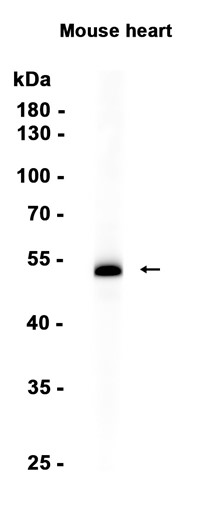
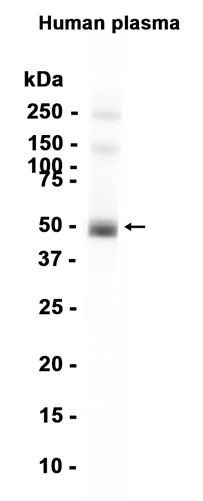
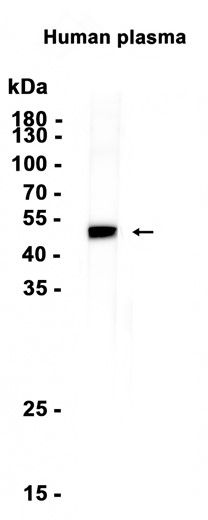
抗原信息
靶点信息
| 研究背景 | Constant region of immunoglobulin (Ig) heavy chains. Igs are membrane-bound or secreted glycoproteins produced by B lymphocytes. In the recognition phase of humoral immunity, the membrane-bound Igs serve as receptors, which upon binding to a specific antigen trigger the clonal expansion and differentiation of B lymphocytes into Ig-secreting plasma cells. Secreted Igs known as antibodies mediate the effector phase of humoral immunity by blocking the interaction of infectious antigens with cellular receptors (via the antigen-binding region) and eliciting effector mechanisms that lead to pathogen neutralization (via the constant region) (PubMed:17576170, PubMed:20176268, PubMed:22158414). The antigen-binding region is formed by the variable domain of one heavy chain paired with the variable domain of its associated light chain. Each Ig molecule has two antigen-binding sites with remarkable affinity for a particular antigen due to V-(D)-J rearrangement, somatic hypermutations and affinity maturation of the variable domains upon antigen exposure (PubMed:17576170, PubMed:20176268, PubMed:22158414). The constant region defines the Ig isotype that perform distinct sets of effector functions. B cells diversify and rearrange their Ig constant regions through class-switch recombination, a process by which the constant region is switched from one Ig isotype to another, namely from IgM and IgD to IgG, IgA and IgE (PubMed:17576170, PubMed:20176268, PubMed:22158414). The constant region of Ig gamma-1 (IgG1) isotype interacts (via the fragment crystallizable, Fc) with receptors on innate immune cells and the complement system to mediate humoral effector functions, including antibody-dependent cellular cytotoxicity or phagocytosis, complement-dependent cytotoxicity and inflammatory responses Constant region of immunoglobulin (Ig) heavy chains. Igs are membrane-bound or secreted glycoproteins produced by B lymphocytes. In the recognition phase of humoral immunity, the membrane-bound Igs serve as receptors, which upon binding to a specific antigen trigger the clonal expansion and differentiation of B lymphocytes into Ig-secreting plasma cells. Secreted Igs known as antibodies mediate the effector phase of humoral immunity by blocking the interaction of infectious antigens with cellular receptors (via the antigen-binding region) and eliciting effector mechanisms that lead to pathogen neutralization (via the constant region) (PubMed:17576170, PubMed:20176268, PubMed:22158414). The antigen-binding region is formed by the variable domain of one heavy chain paired with the variable domain of its associated light chain. Each Ig molecule has two antigen-binding sites with remarkable affinity for a particular antigen due to V-(D)-J rearrangement, somatic hypermutations and affinity maturation of the variable domains upon antigen exposure (PubMed:17576170, PubMed:20176268, PubMed:22158414). The constant region defines the Ig isotype that perform distinct sets of effector functions. B cells diversify and rearrange their Ig constant regions through class-switch recombination, a process by which the constant region is switched from one Ig isotype to another, namely from IgM and IgD to IgG, IgA and IgE (PubMed:17576170, PubMed:20176268, PubMed:22158414). The constant region interacts (via the fragment crystallizable, Fc) with receptors on innate immune cells and the complement system to mediate humoral effector functions. Ig gamma-2 (IgG2) isotype formed against polysaccharide structures found on encapsulated bacteria elicits antibody-dependent protection through activation of complement pathway Constant region of immunoglobulin (Ig) heavy chains. Igs are membrane-bound or secreted glycoproteins produced by B lymphocytes. In the recognition phase of humoral immunity, the membrane-bound Igs serve as receptors, which upon binding to a specific antigen trigger the clonal expansion and differentiation of B lymphocytes into Ig-secreting plasma cells. Secreted Igs known as antibodies mediate the effector phase of humoral immunity by blocking the interaction of infectious antigens with cellular receptors (via the antigen-binding region) and eliciting effector mechanisms that lead to pathogen neutralization (via the constant region) (PubMed:17576170, PubMed:20176268, PubMed:22158414). The antigen-binding region is formed by the variable domain of one heavy chain paired with the variable domain of its associated light chain. Each Ig molecule has two antigen-binding sites with remarkable affinity for a particular antigen due to V-(D)-J rearrangement, somatic hypermutations and affinity maturation of the variable domains upon antigen exposure (PubMed:17576170, PubMed:20176268, PubMed:22158414). The constant region defines the Ig isotype that perform distinct sets of effector functions. B cells diversify and rearrange their Ig constant regions through class-switch recombination, a process by which the constant region is switched from one Ig isotype to another, namely from IgM and IgD to IgG, IgA and IgE (PubMed:17576170, PubMed:20176268, PubMed:22158414). The constant region of Ig gamma-3 (IgG3) isotype interacts (via the fragment crystallizable, Fc) with receptors on innate immune cells and the complement system to mediate humoral effector functions, including antibody-dependent cellular cytotoxicity or phagocytosis, complement-dependent cytotoxicity and inflammatory responses Constant region of immunoglobulin (Ig) heavy chains. Igs are membrane-bound or secreted glycoproteins produced by B lymphocytes. In the recognition phase of humoral immunity, the membrane-bound Igs serve as receptors, which upon binding to a specific antigen trigger the clonal expansion and differentiation of B lymphocytes into Ig-secreting plasma cells. Secreted Igs known as antibodies mediate the effector phase of humoral immunity by blocking the interaction of infectious antigens with cellular receptors (via the antigen-binding region) and eliciting effector mechanisms that lead to pathogen neutralization (via the constant region) (PubMed:17576170, PubMed:20176268, PubMed:22158414). The antigen-binding region is formed by the variable domain of one heavy chain paired with the variable domain of its associated light chain. Each Ig molecule has two antigen-binding sites with remarkable affinity for a particular antigen due to V-(D)-J rearrangement, somatic hypermutations and affinity maturation of the variable domains upon antigen exposure (PubMed:17576170, PubMed:20176268, PubMed:22158414). The constant region defines the Ig isotype that perform distinct sets of effector functions. B cells diversify and rearrange their Ig constant regions through class-switch recombination, a process by which the constant region is switched from one Ig isotype to another, namely from IgM and IgD to IgG, IgA and IgE (PubMed:17576170, PubMed:20176268, PubMed:22158414). The constant region interacts (via the fragment crystallizable, Fc) with the Fc receptors on innate immune cells to mediate humoral effector functions. Ig gamma-4 (IgG4) isotype does not elicit antibody-dependent cellular cytotoxicity (ADDC) or complement-dependent cytotoxicity (CDC). Instead it is likely involved in immune tolerance mechanisms to allergens and parasites either by blocking IgE-antigen complex formation or by directly inhibiting mast cell degranulation through Fc receptor signaling. In the context of tumorigenesis, it may participate in immunosuppressive mechanisms |
|---|---|
| 基因 ID | 3134 |
| 基因名 | IGHG1, IGHG2, IGHG3, IGHG4 |
| Swiss | P01857, P01859, P01860, P01861 |
| 别名 | Human IgG (YD11705),Human IgG (YD11705) Rabbit mAb,IGHG1,IGHG2,IGHG3,IGHG4,Ig gamma-1 chain C region,Ig gamma-1 chain C region EU,Ig gamma-1 chain C region KOL,Ig gamma-1 chain C region NIE,Ig gamma-2 chain C region,Ig gamma-2 chain C region DOT,Ig gamma-2 chain C region TIL |
资料与支持
验证数据
欢迎联系技术支持获取验证图与应用案例。
常见问题
当前页面标注应用包括 WB, IHC-P,建议结合页面验证图和推荐稀释比例进行预实验优化。
可通过页面询价/留言入口提交货号和批号,技术支持会协助提供对应批次资料。
页面推荐条件可作为起始浓度,不同样本、固定方式和检测体系可能需要梯度优化。