
DDX17 Rabbit mAb (货号:AYM28812)
A
小A
销售顾问

请使用微信扫一扫
添加顾问进行咨询
货号
AYM28812
靶点/基因
DDX17
宿主
Rabbit
克隆性
Monoclonal
反应种属
Human, Mouse
应用
WB, IHC, IF/ICC, FC
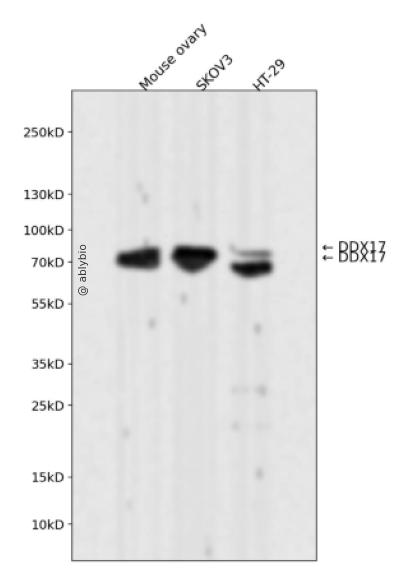
Western blot analysis of DDX17 expressed in Mouse ovary,SKOV3,HT-29 using DDX17 Rabbit mAb at 1:1000. Secondary antibody: HRP Goat Anti-Rabbit IgG (H+L) at 1:5000. Lysates/proteins: 30ug per lane. Blocking buffer: 5% non-fat dry milk in TBST. Detection: ECL Enhanced Kit. Exposure time: 120s.
预览
Western blot - DDX17 Rabbit mAb
Western blot analysis of DDX17 expressed in Mouse ovary,SKOV3,HT-29 using DDX17 Rabbit mAb at 1:1000. Secondary antibody: HRP Goat Anti-Rabbit IgG (H+L) at 1:5000. Lysates/proteins: 30ug per lane. Blocking buffer: 5% non-fat dry milk in TBST. Detection: ECL Enhanced Kit. Exposure time: 120s.
产品信息
应用指南
相关产品
抗原信息
靶点信息
资料与支持
实验步骤
常见问题
| 反应 | Human,Mouse |
|---|---|
| 宿主 | Rabbit |
| 克隆性 | Monoclonal |
| 同种型 | IgG |
| 应用 | WBIHCIF/ICCFC |
| 推荐浓度 | WB: 1:500 - 1:2000 IHC: 1:50 - 1:200 IF/ICC: 1:50 - 1:200 FC: 1:20 - 1:50 |
| 理论分子量 | 72kDa/80kDa |
| 实测分子量 | 70,80kDa |
| 形式 | Liquid |
| 保存条件 | Store at -20℃. Avoid freeze / thaw cycles. Buffer: PBS with 0.75% BSA,50% glycerol,pH7.3. |
| 偶联物 | Unconjugated |
| 阳性对照 | SKOV3,HT-29,Mouse ovary,Mouse brain |
| 细胞定位 | Nucleus,nucleolus |
| 纯化 | Affinity purification |
应用与推荐条件
快速判断怎么用
以下条件基于推荐浓度、验证图说明与通用实验要求整理,可作为预实验起点;不同样本和检测体系建议做梯度优化。
WB
WB 推荐条件
| 推荐稀释 | 1:500 - 1:2000 |
|---|---|
| 建议样本/阳性对照 | SKOV3,HT-29,Mouse ovary,Mouse brain |
| 关键条件 | 建议使用新鲜裂解样本,按推荐稀释比例孵育一抗,并关注理论/实测分子量 |
| 预期结果 | 预期信号/条带约 70,80kDa |
| 对照设置 | 建议设置阳性样本、阴性样本和二抗/同型对照 |
IHC
IHC 推荐条件
| 推荐稀释 | 1:50 - 1:200 |
|---|---|
| 建议样本/阳性对照 | SKOV3,HT-29,Mouse ovary,Mouse brain |
| 关键条件 | 石蜡切片建议优化抗原修复液 pH、修复时间和一抗孵育条件 |
| 预期结果 | 预期定位:Nucleus,nucleolus |
| 对照设置 | 建议设置阳性样本、阴性样本和二抗/同型对照 |
IF/ICC
IF/ICC 推荐条件
| 推荐稀释 | 1:50 - 1:200 |
|---|---|
| 建议样本/阳性对照 | SKOV3,HT-29,Mouse ovary,Mouse brain |
| 关键条件 | 建议优化固定、通透和封闭条件,并设置二抗空白对照 |
| 预期结果 | 预期荧光定位:Nucleus,nucleolus |
| 对照设置 | 建议设置阳性样本、阴性样本和二抗/同型对照 |
FC
FC 推荐条件
| 推荐稀释 | 1:20 - 1:50 |
|---|---|
| 建议样本/阳性对照 | SKOV3,HT-29,Mouse ovary,Mouse brain |
| 关键条件 | 如检测胞内靶点,需优化固定/通透条件,并设置同型对照 |
| 预期结果 | 预期阳性群体荧光信号相对阴性/同型对照右移 |
| 对照设置 | 建议设置阳性样本、阴性样本和二抗/同型对照 |
相关产品
查找相关产品 >>
抗原信息
| 抗原信息 | Recombinant fusion protein corresponding to Human DDX17. |
|---|---|
| 序列 |
查看序列VFAFHHANFPQYVMDVLMDQHFTEPTPIQCQGFPLALSGRDMVGIAQTGSGKTLAYLLPAIVHINHQPYLE |
靶点信息
| 研究背景 | DEAD box proteins, characterized by the conserved motif Asp-Glu-Ala-Asp (DEAD), are putative RNA helicases. They are implicated in a number of cellular processes involving alteration of RNA secondary structure, such as translation initiation, nuclear and mitochondrial splicing, and ribosome and splicesosome assembly. Based on their distribution patterns, some members of this family are believed to be involved in embryogenesis, spermatogenesis, and cellular growth and division. This gene encodes a DEAD box protein, which is an ATPase activated by a variety of RNA species, but not by dsDNA. This protein, and that encoded by DDX5 gene, are more closely related to each other than to any other member of the DEAD box family. This gene can encode multiple isoforms due to both alternative splicing and the use of alternative translation initiation codons, including a non-AUG (CUG) start codon. |
|---|---|
| 基因 ID | 10521 |
| 基因名 | DDX17 |
| Swiss | Q92841 |
| 别名 | DDX17,DDX17 Rabbit mAb,DEAD box protein 17,DEAD box protein p72,DEAD box protein p82,RNA-dependent helicase p72 |
| 组织表达 | Widely expressed (PubMed:8871553). Low expression, if any, in normal colonic epithelial cells (at protein level). Levels tend to increase during colon cancer progression, from very low in benign hyperplastic polyps to very high in tubular and villous adenomas (PubMed:17699760). |
| 功能 | As an RNA helicase, unwinds RNA and alters RNA structures through ATP binding and hydrolysis. Involved in multiple cellular processes, including pre-mRNA splicing, alternative splicing, ribosomal RNA processing and miRNA processing, as well as transcription regulation. Regulates the alternative splicing of exons exhibiting specific features (PubMed:12138182, PubMed:23022728, PubMed:24910439, PubMed:22266867). For instance, promotes the inclusion of AC-rich alternative exons in CD44 transcripts (PubMed:12138182). This function requires the RNA helicase activity (PubMed:12138182, PubMed:23022728, PubMed:24910439, PubMed:22266867). Affects NFAT5 and histone macro-H2A.1/H2AFY alternative splicing in a CDK9-dependent manner (PubMed:26209609, PubMed:22266867). In NFAT5, promotes the introduction of alternative exon 4, which contains 2 stop codons and may target NFAT5 exon 4-containing transcripts to nonsense-mediated mRNA decay, leading to the down-regulation of NFAT5 protein (PubMed:22266867). Affects splicing of mediators of steroid hormone signaling pathway, including kinases that phosphorylates ESR1, such as CDK2, MAPK1 and GSK3B, and transcriptional regulators, such as CREBBP, MED1, NCOR1 and NCOR2. By affecting GSK3B splicing, participates in ESR1 and AR stabilization (PubMed:24275493). In myoblasts and epithelial cells, cooperates with HNRNPH1 to control the splicing of specific subsets of exons (PubMed:24910439). In addition to binding mature mRNAs, also interacts with certain pri-microRNAs, including MIR663/miR-663a, MIR99B/miR-99b, and MIR6087/miR-6087 (PubMed:25126784). Binds pri-microRNAs on the 3' segment flanking the stem loop via the 5'-[ACG]CAUC[ACU]-3' consensus sequence (PubMed:24581491). Required for the production of subsets of microRNAs, including MIR21 and MIR125B1 (PubMed:24581491, PubMed:27478153). May be involved not only in microRNA primary transcript processing, but also stabilization (By similarity). Participates in MYC down-regulation at high cell density through the production of MYC-targeting microRNAs (PubMed:24581491). Along with DDX5, may be involved in the processing of the 32S intermediate into the mature 28S ribosomal RNA (PubMed:17485482). Promoter-specific transcription regulator, functioning as a coactivator or corepressor depending on the context of the promoter and the transcriptional complex in which it exists (PubMed:15298701). Enhances NFAT5 transcriptional activity (PubMed:22266867). Synergizes with TP53 in the activation of the MDM2 promoter; this activity requires acetylation on lysine residues (PubMed:17226766, PubMed:20663877, PubMed:19995069). May also coactivate MDM2 transcription through a TP53-independent pathway (PubMed:17226766). Coactivates MMP7 transcription (PubMed:17226766). Along with CTNNB1, coactivates MYC, JUN, FOSL1 and cyclin D1/CCND1 transcription (PubMed:17699760). Alone or in combination with DDX5 and/or SRA1 non-coding RNA, plays a critical role in promoting the assembly of proteins required for the formation of the transcription initiation complex and chromatin remodeling leading to coactivation of MYOD1-dependent transcription. This helicase-independent activity is required for skeletal muscle cells to properly differentiate into myotubes (PubMed:17011493, PubMed:24910439). During epithelial-to-mesenchymal transition, coregulates SMAD-dependent transcriptional activity, directly controlling key effectors of differentiation, including miRNAs which in turn directly repress its expression (PubMed:24910439). Plays a role in estrogen and testosterone signaling pathway at several levels. Mediates the use of alternative promoters in estrogen-responsive genes and regulates transcription and splicing of a large number of steroid hormone target genes (PubMed:24275493, PubMed:20406972, PubMed:20663877, PubMed:19995069). Contrary to splicing regulation activity, transcriptional coregulation of the estrogen receptor ESR1 is helicase-independent (PubMed:19718048, PubMed:24275493). Plays a role in innate immunity. Specifically restricts bunyavirus infection, including Rift Valley fever virus (RVFV) or La Crosse virus (LACV), but not vesicular stomatitis virus (VSV), in an interferon- and DROSHA-independent manner (PubMed:25126784). Binds to RVFV RNA, likely via structured viral RNA elements (PubMed:25126784). Promotes mRNA degradation mediated by the antiviral zinc-finger protein ZC3HAV1, in an ATPase-dependent manner (PubMed:18334637). |
| 研究领域 |
资料与技术支持
验证数据
1 张验证图
页面顶部轮播可查看应用验证图,覆盖 WB / IHC / IF/ICC / FC。
常见问题
当前页面标注应用包括 WB, IHC, IF/ICC, FC,建议结合页面验证图和推荐稀释比例进行预实验优化。
可通过页面询价/留言入口提交货号和批号,技术支持会协助提供对应批次资料。
页面推荐条件可作为起始浓度,不同样本、固定方式和检测体系可能需要梯度优化。